HIST 304: Greek Civilization  ·  Stephenson  ·  greekciv.com

Gods, Monsters, and the Transmission of Myths

From Tiamat to Typhon — chaos, combat, and the divine order of the ancient world

A parallel timeline tracing the cognate relationships between Near Eastern and Greek gods: the storm sovereign, the dying and rising god, the love and war goddess, the underworld, and the great flood. The question is not whether Greece borrowed from the East — it demonstrably did — but how, when, and through whom. The trading post at al-Mina and the Euboean sailors who frequented it are central to the answer — but centuries before any of that transmission, the gods themselves are already visible in the Bronze Age Aegean's own material record: named in Linear B tablets, worn as rings by a warrior buried at Pylos, and left as a smashed ivory statue on Crete. Cards flagged ⚑ Lecture 4 below mark material this week's lecture, “Gods and Monsters,” covers directly.

Mesopotamia (Sumerian / Akkadian / Babylonian)
Anatolian / Hittite
Ugaritic / Canaanite / Phoenician
Egyptian
Collapse / disruption
Cognate chain / direct parallel
Cultural transmission
Greek Aegean (all periods)
Near East & Egypt
Mesopotamia · Anatolia · Ugarit · Egypt
date
Greek Aegean
Minoan · Mycenaean · Archaic · Classical
Primordial Cosmogony & the First Pantheon c. 3,000 – 2,000 BCE
🌏
The first gods are forces of nature. Across every tradition in this timeline, the earliest divine figures personify water, sky, earth, storm, and the underworld. The Sumerian pantheon is the oldest written record of this universal pattern. Greek equivalents will appear 2,000 years later bearing the same structural roles — often with recognisably cognate names or attributes.
c. 3,000 BCE · Sumer, southern Mesopotamia
The Sumerian Great Triad: An, Enlil, Enki origin
An (sky / heaven) is the supreme father of the gods but largely passive — a celestial authority rather than an active ruler. Enlil (wind / storm) holds practical sovereignty: he issues divine decrees, grants kingship, and sends the flood. Enki (fresh water / wisdom / craft) is the cunning creator who shapes humanity from clay. Together they map onto the Greek Zeus-Poseidon-Hephaestus triad in function if not in direct genealogy.
Oxford ETCSL — Enlil in the E-kur (Enlil A): a primary Sumerian hymn to Enlil
ISAC Chicago — Jacobsen, “The Cosmos as a State” in The Intellectual Adventure of Ancient Man (PDF, open access)
c. 2,600 BCE · Sumer
Inanna: love, war, and the descent to the underworld key figure
Inanna (later Ishtar in Akkadian) is the most complex deity in the Sumerian pantheon: goddess of love, sexual desire, war, and justice. Her descent to the underworld to challenge her sister Ereshkigal — stripping off her divine powers gate by gate and dying, then rising again — is the first recorded narrative of a dying and rising deity. Its structural echo in the Persephone myth, separated by 2,000 years, is one of the most debated questions in classical scholarship.
Oxford ETCSL — Descent of Inanna, full text
c. 2,100 BCE · Sumer
Dumuzi: the dying shepherd-god
Inanna’s consort Dumuzi is sent to the underworld as her replacement when she returns from the dead. He dies each year and is mourned by his sister Geshtinanna; his seasonal death and partial revival structures the agricultural year. Dumuzi becomes Tammuz in Akkadian tradition, Adonis in the Phoenician-Greek synthesis, and leaves a faint but real trace in the lament tradition that surrounds Dionysus.
3,000 BCE
2,600 BCE
2,100 BCE
c. 2,800 – 2,000 BCE · Crete and Cyclades
Early Minoan: goddess figurines, no written mythology
Clay and stone figurines from Early Minoan Crete show a dominant female divine figure — sometimes with raised arms, sometimes with snakes. Whether she is one goddess or many, a mother goddess or a nature deity, remains contested. No written mythology survives from the Aegean at this period. The oral traditions that will become Greek myth are forming without any text to preserve them.
Minoan Snake Goddess figurine, Knossos c.1600 BCE
Snake Goddess, Knossos, c. 1600 BCE. Faience figurine, Heraklion Archaeological Museum. Her attributes — entwined snakes, raised arms, exposed torso — mark her as a deity of nature and power. This is the closest visual evidence we have for Minoan religious imagery before any written mythology survives in the Aegean.
Heraklion Archaeological Museum — Neopalatial collection
c. 3,000 – 600 BCE · Five mythological zones
Geographic overview: where each pantheon originates
The map opposite shows the five major divine traditions traced in this timeline. Each zone produced a structurally similar but culturally distinct pantheon. The shading follows the colour coding of this timeline’s legend: amber (Mesopotamia), teal (Anatolia), purple (Ugarit/Levant), gold (Egypt), terracotta (Greek Aegean).
geographic context
The world of the gods: five mythological zones
Loading map…

Each shaded zone produced a distinct but structurally related pantheon. The cognate chains on this timeline trace how divine roles — storm sovereign, love-war goddess, craftsman god — cross these boundaries.

Mesopotamia
Anatolia / Hittite
Ugarit / Levant
Egypt
Greek Aegean
Bronze Age Flowering — Enuma Elish & the Kumarbi Cycle c. 2,000 – 1,400 BCE
c. 1,800 BCE · Babylon (oral tradition older)
Enuma Elish: Marduk defeats Tiamat, creates the world key text
The Babylonian creation epic. The primordial salt-sea Tiamat (female, chaos) and her consort Apsu (fresh water) engender the gods. When the younger gods disturb the primordial order, Tiamat raises an army. Marduk, champion of the Olympian-style younger gods, defeats her: he splits her body to make sky and earth. The pattern — younger storm-god defeats primordial chaos-monster to establish divine order — reappears in Hesiod’s Theogony as Zeus’s defeat of Typhon, and in the broader Greek cosmic battle tradition.
Sacred Texts — Enuma Elish, full English translation
c. 1,750 BCE · Babylon
The Atrahasis Epic — flood, creation, and divine anger
The gods create humans to relieve them of agricultural labour. Humanity multiplies and makes too much noise; Enlil sends flood, plague, and drought to reduce their numbers. Finally the great flood. Atrahasis (the “extra-wise one”) is warned by Enki and survives in a boat. The structural parallel to Deucalion’s flood in Hesiod’s Catalogue of Women and to the Noachic tradition is inescapable: a single just man saved from divine destruction by a sympathetic deity.
Livius.org — Epic of Atrahasis, translated text (ANET pp. 104–106)
1,800 BCE
1,750 BCE
1,700 BCE
c. 1,700 – 1,400 BCE · Anatolia (Hittite Empire)
The Kumarbi Cycle: the succession myth that prefigures Hesiod key parallel
The Hittite Song of Kumarbi and the Song of Ullikummi describe the succession of sky gods: Alalu rules, is deposed by Anu (sky), who is then deposed by Kumarbi, who bites off and swallows Anu’s genitals. From this act Teshub (the storm god) is born — and eventually defeats Kumarbi to become king of the gods. The structural parallel to Hesiod’s Theogony — Ouranos castrated by Kronos, Kronos swallowing his children, Zeus defeating Kronos — is so precise that it cannot be coincidental. This is the single most important Near Eastern parallel to Greek mythology, and it comes from Anatolia: the same corridor that delivered the farming package to Greece.
Melammu Project — Kumarbi and the succession myth
Cognate chain
The succession myth: Kumarbi castrates Anu → Kronos castrates Ouranos (Hesiod, Theogony ll. 154–182). Both produce a storm-god son (Teshub / Zeus) who defeats his father and becomes king of the gods. Both texts describe successive divine generations, cosmic battle, and the establishment of a new divine order. Martin West (1997) calls this “the most striking case of contact between Greek and Near Eastern myth.”
c. 1,550 BCE · Egypt (New Kingdom)
Osiris, Isis, Seth — the Egyptian dying and rising complex
Osiris (vegetation, Nile flood, kingship) is killed by his brother Seth (chaos, desert), dismembered, and resurrected by his wife-sister Isis. Their son Horus defeats Seth to restore order. The pattern — ordered divine king killed by chaos, reassembled by a female figure, avenged by a son — is structurally parallel to the Dumuzi-Inanna-Tammuz complex and, more distantly, to Dionysus (dismembered by the Titans, reassembled). Egyptian religious iconography will strongly influence Phoenician syncretism and via that route filter into archaic Greek religion.
1,550 BCE
1,500 BCE
c. 1,600 – 1,200 BCE · Mycenaean Greece
Linear B tablets: the Olympians are already named key date
Linear B tablets from Pylos, Knossos, and Thebes name Zeus, Hera, Poseidon, Dionysus, Athena, Artemis, Hermes, and Ares as recipients of ritual offerings. The Greek pantheon is established — in recognisable form — by the Bronze Age. What is not yet present: any surviving narrative mythology. The stories that explain these gods’ relationships, origins, and conflicts will only be crystallised in writing by Hesiod and Homer, five centuries later. These same archives are administrative, not literary — a Pylos tablet (PY Ep 704) records a land dispute between the priestess Eritha and the local damos (community, later dēmos) over temple estates, showing palace, temple, and community as three distinct, sometimes competing interests. And the god who receives the most, by far, is not Zeus: it is Poseidon.
DAMØS Oslo — searchable Linear B database search the deity names (e.g. di-we = Zeus) within the database
PalaeoLexicon — Linear B word study tool with tablet cross-references use the site search to look up individual Linear B terms
UT Austin Repository — Palaima, “The Last Days of the Pylos Polity” (with tablet translations)
Mycenaean pottery, National Archaeological Museum Athens
Mycenaean pottery, c. 1400–1200 BCE. National Archaeological Museum, Athens. Vessels like these carried Mycenaean olive oil to Egypt and the Levant — the material trace of the Bronze Age contact network through which divine names and narrative structures first circulated between the Aegean and the Near East.
Hephaestus on red-figure cup, Berlin
Hephaestus at his forge, Attic red-figure cup, c. 490 BCE. Antikensammlung, Berlin. Structurally identical to the Ugaritic Kothar-wa-Khasis: the craftsman-god who serves the king of heaven by forging the weapon that defeats chaos.
🏙
What predates Hesiod is not always a text. Two Cretan finds — one excavated only in 2015 — show how much of this religious world survives as an object with no story attached to it at all.
c. 1,900 – 1,300 BCE · Egypt
Taweret — the hippopotamus goddess of childbirth and protection
Taweret — upright, pregnant, part hippopotamus, part lion, part crocodile — guards households and birth throughout Egyptian religion. Carried abroad through Egypt’s contacts with the Levant and the Aegean, her image was reworked far from home: by the Bronze Age Aegean she has become a winged, composite “genius” attending eastern Mediterranean goddesses — the protective function kept, the original goddess unrecognisable.
1,900–1,300 BCE
c. 1,450 BCE
c. 1,450 BCE · Pylos
The Griffin Warrior’s grave — a Mycenaean ruler buried with Minoan gods 2015 discovery
An un-robbed shaft grave excavated at Pylos in 2015 held a man of about thirty-five, buried c. 1450 BCE with bronze armour, a boar’s-tusk helmet, a gold-pommelled sword, four gold signet rings, and more than fifty engraved seal-stones — named the “Griffin Warrior” for an ivory plaque of a griffin found with him. Three of his four rings show goddesses; his weapons lay on his left side, his rings and seals on his right, as if keeping the mundane and the divine apart. One seal shows two winged genii — descended from Taweret, opposite — flanking an altar and sacred tree, setting the warrior under a goddess’s protection. Another, the Combat Agate, just 3.5 cm across, engraves a duel with anatomical detail unmatched in Greek art for a thousand years. He held this imagery generations before any Linear B tablet uses the word wanax, “king.”
Davis & Stocker, “The Lord of the Gold Rings: The Griffin Warrior of Pylos,” Hesperia 85 (2016): 627–55 — search this title in JSTOR
c. 1,480 – 1,450 BCE · Palaikastro, eastern Crete
The Palaikastro Kouros — a god’s image, deliberately destroyed
A chryselephantine (gold-and-ivory) statue of a striding youth, about 50 cm tall, stood in a town shrine at Palaikastro beside a polished green-serpentine baetyl — a stone at which a god could be summoned. Before the shrine burned, someone carried the statue into the street, smashed its head into hundreds of pieces, and threw the legs back inside: a deliberate destruction, perhaps meant to keep a god’s image from falling into the wrong hands. Three seasons of excavation (1987–90) recovered two hundred fragments; reassembly took most of a decade. Centuries later, after a gap in occupation, the sanctuary of Diktaian Zeus was built over the same ruins — a Cretan tradition in which Zeus, unlike the Zeus of the mainland, is born, dies, and is born again each year.
MacGillivray, Driessen & Sackett (eds.), The Palaikastro Kouros (BSA Studies 6, London, 2000) — search this title in JSTOR / your library catalogue
Ugarit & the Baal Cycle c. 1,400 – 1,200 BCE
c. 1,400 – 1,200 BCE · Ugarit (modern Ras Shamra, Syria)
The Baal Cycle: storm god defeats sea and death key text
Discovered only in 1929, the Ugaritic Baal Cycle transformed understanding of Greek mythology’s origins. El is the aged father of the gods — passive, authoritative, sexually active — a closer parallel to Kronos than to Zeus. Baal (storm, rain, fertility) fights Yam (sea, chaos, rivers) and defeats him with two magic weapons forged by the craftsman-god Kothar-wa-Khasis; he then fights and temporarily succumbs to Mot (death), before being restored to life. Every element of this cycle — storm god versus sea, craftsman who forges divine weapons, seasonal death and revival — reappears in Homer and Hesiod.
Marquette University — Baal and Yam: translated text with notes (PDF)
Gibson, “The Theology of the Ugaritic Baal Cycle,” Orientalia 53.2 (1984): 202–219 — search this title in JSTOR
c. 1,400 BCE · Ugarit
Asherah, Anat, Astarte — the Canaanite goddess complex
Asherah (mother of the gods, sea) is El’s consort: queenly, interceding. Anat (war, hunting) is violent and protective — she wades through blood, yet is also Baal’s sister and defender. Astarte (love, war, Venus) is the Canaanite-Phoenician form of Inanna/Ishtar. All three feed into the bifurcated Greek tradition: Hera (queenly consort), Athena (war, craft), and Aphrodite (love, beauty). The Phoenician syncretism of Astarte and Aphrodite is explicitly noted by Herodotus.
Baal stele from Ugarit, c.1400-1200 BCE, Louvre
Baal with Thunderbolt, stele from Ugarit, c. 1400–1200 BCE. Louvre, Paris (AO 15775). Baal strides forward wielding a mace and a stylised thunderbolt-spear. This is the canonical image of the Ugaritic storm god — the closest visual parallel to later Greek depictions of Zeus with his thunderbolt.
Wikimedia Commons (public domain)
1,400 BCE
1,300 BCE
c. 1,400 – 1,200 BCE · Mycenaean Greece / Aegean
Mycenaean Bronze Age: intensive contact with the Levant
Mycenaean pottery is found at Ugarit; Ugaritic goods reach Mycenae. This is the period of maximum Bronze Age cultural exchange across the Eastern Mediterranean. Mythological material need not travel as text: it travels with traders, mercenaries, and craftsmen. The craftsman-god parallel (Kothar-wa-Khasis / Hephaestus) likely enters the Aegean world through this contact zone, along with elements of the divine smith tradition and possibly aspects of the dying-god narrative.
Cognate chain
Storm god versus sea: Baal defeats Yam (Ugaritic Baal Cycle) → Zeus defeats Typhon (Hesiod, Theogony ll. 820–880) → Poseidon’s dominion over the sea. The Ugaritic Yam is the sea as chaos; the Greek Poseidon is the sea as power and anger. Both are subordinated to the sky-storm sovereign. Kothar-wa-Khasis (forges Baal’s weapons) → Hephaestus (forges Zeus’s thunderbolts). The craftsman who serves the king of the gods is structurally identical in both traditions. A complication worth holding onto: “Poseidon’s dominion over the sea” is a later, literary fact. No surviving Linear B tablet connects him with the sea at all — in the Bronze Age archive he simply has the largest cult of any god.
Bronze Age Collapse & the Hittite Legacy c. 1,200 – 900 BCE
c. 1,180 BCE · Eastern Mediterranean broadly
The Hittite Empire collapses; Ugarit is destroyed rupture
The Sea Peoples’ incursions, combined with drought, internal rebellion, and the collapse of Bronze Age trade networks, destroy the Hittite empire within a generation. Ugarit is burned c. 1,185 BCE and never rebuilt — taking its clay-tablet library (including the Baal Cycle) out of living circulation for three thousand years, until rediscovery in 1929. The Kumarbi Cycle texts survive only because Hittite scribal copies were preserved at Hattusa (modern Boğazköy). The direct Bronze Age transmission route from Anatolia and Syria to Greece is severed.
c. 1,100 – 900 BCE · Phoenicia (modern Lebanon)
Phoenicians become the custodians of Near Eastern mythological tradition
As the Hittite empire and Ugarit collapse, the Phoenician city-states — Tyre, Sidon, Byblos — survive and become the dominant cultural intermediaries between the Near East and the Mediterranean world. Phoenician merchants carry an Astarte-centred religious tradition, a version of the Baal Cycle, and (crucially) the alphabetic script that will become the Greek alphabet. They are the living conduit between the world of Ugarit and the world of Homer. The religious scholar Sanchuniathon (whose Phoenician history survives in Greek summary via Philo of Byblos) preserves fragments of Canaanite mythology that show direct structural parallels to Hesiod.
1,180 BCE
1,000 BCE
c. 1,200 – 900 BCE · Greek Aegean
Greek Dark Ages: mythological tradition goes underground
The Mycenaean palace system collapses; Linear B writing disappears; population contracts sharply. The Olympian gods established in the Linear B tablets survive — but the myths that explain them must now be transmitted entirely orally. The bards (aoidoi) who will eventually produce Homer are already active in this period, preserving and reshaping a tradition that blends Mycenaean memory, Bronze Age Near Eastern contact, and new Iron Age experience. The gap between the named gods of Linear B and the fully-formed narrative gods of Homer is the gap that oral tradition fills.
Rupture and survival: what crosses the 1,200 BCE divide? Direct textual transmission does not survive the collapse. What survives: Phoenician oral and ritual tradition carrying Canaanite divine figures; Hittite scribal copies of the Kumarbi Cycle preserved at Hattusa; the Greek oral epic tradition carrying Mycenaean divine names without their mythological narratives. The re-connection will happen in the Iron Age, at al-Mina.
c. 1,185 – 800 BCE · Transmission corridor
How Near Eastern myth reached Greece after the collapse
With Ugarit destroyed and the Hittite empire gone, the Phoenician cities become the living link between the Bronze Age mythological tradition and the Greek world. The map opposite traces the specific route: Ugarit → Phoenician coast → al-Mina (the critical contact point) → Euboean network → mainland Greece.
transmission corridor
Euboean transmission of eastern myth
Loading map…

Robin Lane Fox’s thesis: Euboean sailors operating from al-Mina (mouth of the Orontes, c. 825 BCE) encountered living Phoenician and Aramaic mythological traditions. The dotted line traces their sea route home — along the Levantine coast, around Cyprus, across the Aegean — carrying those narratives to the world of Hesiod.

Phoenician / Ugaritic
Al-Mina (contact point)
Greek Euboean network
Al-Mina & the Euboean Corridor c. 900 – 720 BCE

The al-Mina Thesis — Robin Lane Fox, Travelling Heroes (2008)

Al-Mina, at the mouth of the Orontes river on the Syrian coast (modern southern Turkey), was established as a trading post c. 825 BCE. The earliest pottery layers are dominated by Euboean wares — the distinctive ceramics of the island of Euboea, whose merchants (from Chalcis and Eretria) were the most adventurous long-distance traders of the early Iron Age Greek world. Lane Fox argues that these Euboean “travelling heroes” encountered, at al-Mina and at the Aramaic-speaking communities of northern Syria, living versions of mythological traditions that descended from the Ugaritic and Hittite Bronze Age: the Baal Cycle, the Kumarbi Cycle, and stories of Gilgamesh. Returning to Euboea and the wider Greek world, they brought these narratives — not as texts, but as stories, images, and ritual forms — that fed directly into the mythological synthesis Hesiod and Homer were then producing. The Phoenician alphabet, almost certainly adopted by Greeks in this same al-Mina milieu around 800 BCE, is the material trace of this encounter.

Persée — Courbin, “Fragments d’amphores protogéométriques grecques à Ras el-Bassit / al-Mina” (peer-reviewed) Wiley — Boardman, “Al Mina and History”, Oxford Journal of Archaeology (peer-reviewed)  ·  Lane Fox, Travelling Heroes — Internet Archive (full text)

c. 825 BCE · Al-Mina, mouth of the Orontes, Syria
Al-Mina trading post: Euboeans and Phoenicians share a harbour key site
The excavation of al-Mina by Leonard Woolley (1936) revealed layered occupation from c. 825 BCE, with Euboean pottery dominant in the earliest levels. The site sat at the intersection of Phoenician, Aramaic, and Assyrian cultural worlds. Local scribes were copying Aramaic versions of Gilgamesh; Phoenician traders were carrying Astarte-tradition and the Baal Cycle westward; Assyrian imperial expansion was forcing mythological and religious syncretism across the whole region. This is the cultural environment in which Greek sailors were shopping, trading, drinking, and — according to Lane Fox — listening to stories.
c. 800 BCE · Levant / Aegean contact zone
The Phoenician alphabet is adopted by Greeks key date
The adoption of the Phoenician consonantal alphabet and its adaptation (with the crucial addition of vowels) into the Greek alphabet is almost certainly a product of Levantine contact — very possibly at al-Mina itself or in Euboean communities with close Phoenician ties. The first Greek alphabetic inscriptions date to c. 800–775 BCE and are associated with Euboean communities. This is not merely a technical development: it is the medium through which Near Eastern mythological content will eventually be written down as Homer and Hesiod.
825 BCE
800 BCE
780 BCE
c. 825 – 720 BCE · Euboea (Chalcis and Eretria)
Euboean traders: the “travelling heroes” who carried mythology westward
The Euboeans were the first Greeks to re-establish long-distance maritime trade after the Dark Ages, sailing east to al-Mina and west to Pithekoussai (modern Ischia, near Naples) — the earliest Greek settlement in the western Mediterranean. Lane Fox argues that this same network of sailors, who were steeped in Aramaic and Phoenician storytelling traditions at al-Mina, returned to the Greek world carrying narratives of divine succession, cosmic battle, and the dying god. Their Euboean home was close to Boeotia — Hesiod’s home — and to the circuit of competitive festivals where epic poetry was performed.
c. 800 – 750 BCE · Pithekoussai (Ischia) — western end of the Euboean network
The Cup of Nestor: Homer’s world inscribed in the West
A cup found in a child’s grave at Pithekoussai (c. 720 BCE) bears one of the earliest Greek alphabetic inscriptions — a witty verse referencing “the cup of Nestor” from the Iliad. It proves that Homeric tradition was already circulating in the far west via Euboean networks within a generation of the poems’ composition. The same network that carried mythology east to al-Mina was broadcasting it westward to Italy. Hesiod and Homer are not the origin of Greek mythology: they are its first fixed written points in a much older and wider oral tradition.
Cup of Nestor inscription, Pithekoussai, c.720 BCE
“Cup of Nestor” inscription, Pithekoussai (Ischia), c. 720 BCE. One of the earliest Greek alphabetic inscriptions: a scratched verse on a kotyle found in a child’s grave, referencing the Homeric Nestor’s cup. Proves Homeric tradition was already circulating in the Euboean west within a generation of the poems’ composition.
Wikimedia Commons (public domain)
The Euboean corridor: Near Eastern myth enters Greek literature through living contact, not through texts Lane Fox’s core argument: mythological transmission at al-Mina was oral, imagistic, and ritual — not scribal. Greeks at al-Mina encountered temple iconography of Baal, performance of the Gilgamesh story in Aramaic, Phoenician ritual traditions involving Astarte and Adonis. These were absorbed as patterns, images, and narrative structures, then re-expressed in Greek by the generation of Homer and Hesiod. Walter Burkert (1992) calls this process “orientalizing”: not borrowing but transformation under eastern influence.
Hesiod & Homer: The Greek Synthesis c. 750 – 600 BCE
c. 750 – 700 BCE · Phoenicia / northern Syria
Sanchuniathon’s Phoenician history — cognates of Hesiod’s succession myth
Philo of Byblos (1st–2nd c. CE) claims to translate an ancient Phoenician cosmogony by Sanchuniathon. Whatever its actual date, the material describes a sequence of divine generations with a sky god castrated by his son — a direct parallel to both the Kumarbi Cycle and Hesiod’s Theogony. The survival of this tradition in Phoenician culture is consistent with the Lane Fox thesis: the Euboeans at al-Mina were encountering precisely this living mythological tradition.
750–700 BCE
700 BCE
c. 750 BCE · Ionia (Homer) & c. 700 BCE · Boeotia (Hesiod)
Homer’s Iliad and Odyssey: Near Eastern structures in Greek dress key text
The divine machinery of the Iliad — the assembly of the gods on Olympus, the quarrel between Zeus and Hera, Hephaestus as smith-outsider, Aphrodite as war-goddess — maps closely onto the Ugaritic divine assembly presided over by El. The Odyssey’s Calypso episode is structurally parallel to the Gilgamesh episode with the divine barmaid Siduri. Homer is not copying Near Eastern texts; he is drawing on a shared narrative grammar that reached the Greek world via the Euboean contact network.
Theoi.com — Hesiod, Theogony, full text
c. 700 BCE · Boeotia
Hesiod’s Theogony: the Kumarbi Cycle in Greek key text
Hesiod’s Theogony is the Greek succession myth: Chaos → Gaia → Ouranos (castrated by Kronos with an adamantine sickle) → Zeus defeats the Titans → Zeus defeats Typhon → the Olympian order established. Every structural element — the castration of the sky god, the swallowing of children, the generational succession, the cosmic battle against a chaos-monster — has a direct Hittite or Babylonian parallel. Hesiod writes from Boeotia, a region geographically close to the Euboean cities (Chalcis, Eretria) whose sailors had spent a century at al-Mina. The coincidence is too neat to be coincidental. Hesiod is the point where eastern narrative tradition becomes Greek literary canon.
Network visualization of Hesiod Theogony genealogy, University of Pennsylvania
Network visualization of Hesiod’s Theogony. Each node is a divine figure; shape encodes category (star = Primordial, circle = Titan, inverted triangle = Olympian, square = Monster); colour encodes gender (pink = female, blue = male, gold = unspecified). Red lines are genealogical connections from the node with the most offspring — Tethys, the Titaness of the ocean stream, who generates an entire world of river-gods and Oceanids. Note how the sea deities (lower centre: Pontos, Phorkys, Doris, Nereis…) and the mountain/sky deities (Olympians, upper right) form almost entirely separate clusters with almost no cross-links — two divine worlds that barely intersect.
University of Pennsylvania Classics — interactive Theogony genealogy
Two divine worlds that barely touch: mountain and sea. The network visualization above makes visible something easy to miss when reading the Theogony as linear narrative: the pantheon divides into two clusters with almost no genealogical connections between them. The mountain and sky world — Olympus, the Titans, the twelve Olympians — is the world of sovereignty, craft, war, and wisdom. The sea world — Pontos (born directly from Gaia without a father), Phorkys and Keto (parents of the sea-monsters), Nereus (the “Old Man of the Sea”), Doris, the fifty Nereids — is a separate divine order, older in some respects, and never defeated by Zeus, simply left alone. This is not merely genealogical: it encodes a theology of the Greek landscape. Mountains are where you encounter the gods of civilization; the sea is where you encounter something older, more dangerous, and only partially knowable. Hesiod describes this separation; Homer’s Odyssey dramatises it — every time Odysseus enters the sea, he leaves the world governed by Zeus and enters the domain of Poseidon, Circe, Calypso, Scylla, and Charybdis. The two divine worlds barely intersect — and the hero who crosses between them pays for it for ten years.
c. 700 BCE · Boeotia
Hesiod’s Works and Days: Prometheus and the Five Ages key text
The Prometheus story — the theft of fire from the gods, the punishment, Pandora’s jar — is Hesiod’s theodicy: an explanation for why human life is hard. The five ages (Gold, Silver, Bronze, Heroes, Iron) are a declining-age scheme with parallels in Mesopotamian royal traditions. Prometheus as culture-hero who steals from the gods and is punished has structural parallels in the Sumerian story of Enki and Adapa. The Works and Days also preserves the fullest Greek account of Deucalion’s flood — the Greek cognate of Atrahasis and Utnapishtim.
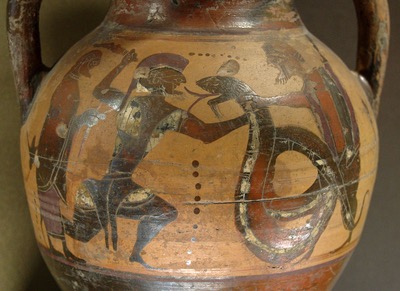
Zeus fighting Typhon, Chalcidian black-figure hydria c.540 BCE
Zeus fighting Typhon, Chalcidian black-figure hydria, c. 540 BCE. Antikensammlungen, Munich. Zeus hurls his thunderbolt at the serpentine Typhon — storm god with divine weapon against chaos-monster. Compare the Baal stele opposite: the visual grammar of this image is eight centuries older than this pot.
Theoi.com — Zeus and Typhon, vase paintings gallery
Full cognate map
Storm god / sky sovereign: Enlil → Marduk (Babylon) → Teshub (Hittite) → Baal (Ugarit) → Zeus  |  Sea / chaos: Tiamat → Yam → Poseidon / Typhon  |  Love & war goddess: Inanna → Ishtar → Astarte (Phoenician) → Aphrodite  |  Dying god: Dumuzi → Tammuz → Adonis (Phoenician-Greek) → Dionysus (aspects)  |  Underworld descent: Inanna’s descent → Persephone / Homeric Hymn to Demeter  |  Craftsman god: Kothar-wa-Khasis (Ugarit) → Hephaestus  |  Flood survivor: Utnapishtim / Atrahasis → Deucalion
c. 700 BCE · Delphi and the wider Greek world
Apollo and the Python — the serpent-slayer who almost replaced Zeus forward link
Apollo’s slaying of the Python at Delphi is structurally identical to every serpent-combat myth on this timeline: Zeus defeats Typhon, Baal defeats Yam, Marduk defeats Tiamat. All involve a sky or solar deity destroying a primordial chaos-serpent to establish divine order. Some scholars have argued that Apollo, not Zeus, was destined to become the supreme deity of the Greek world — younger, more rational, more aligned with the emerging philosophical tradition. The Axial Age intervened: as Greek thought moved toward abstraction and eventually monotheism, the serpent-slaying pattern found its final expression not in a new divine king but in the combat myths of the Hebrew Bible (Yahweh defeating Leviathan and Rahab) and ultimately in the Book of Revelation’s Dragon. The same Canaanite cosmic enemy — Yam, Leviathan, the sea-beast — reappears as the Beast of the Sea in Revelation 13, and as the Dragon defeated by the Archangel Michael. The serpent column at Delphi, erected after the Persian Wars from the bronze of captured weapons, stood for a millennium as the material embodiment of this serpent-conquest tradition — from Delphi to Constantinople, where Constantine moved it in 324 CE.

See: Stephenson, P. The Serpent Column: A Cultural Biography (Oxford University Press, 2016) — traces all these serpent-slaying myths from Bronze Age Canaan through classical Greece, Christianity, and Byzantium.
Stephenson, The Serpent Column: A Cultural Biography (OUP, 2016) — full text on the author’s Academia.edu profile
700–300 BCE
Apollo fights the Python: Delphi, c. 700 BCE onward
The solar god versus the serpent — prelude to the Axial Age
The Homeric Hymn to Apollo describes Apollo arriving at Delphi and slaying the Python, a great serpent sent by Hera. He then establishes his oracle at the site, which becomes the most authoritative religious centre in Greece. The episode positions Apollo — god of reason, music, prophecy, and light — as a culture-hero who defeats chaos and establishes a new rational order. Hesiod’s Works and Days already hints at this tension: Zeus governs through power and justice; Apollo represents the possibility of a different kind of sovereignty, based on knowledge and prophecy rather than force. The parallel with the emerging Hebrew tradition of a single righteous god who defeats the sea-dragon (Psalm 74, Isaiah 27) is not coincidental: both traditions draw on the same Canaanite mythological substrate visible in the Baal Cycle, filtered through the same Iron Age contact networks this timeline has traced.
Apollo slaying the Python, ancient Greek red-figure vase painting
Apollo slaying the Python, red-figure vase painting. Apollo draws his bow against the coiled Python at Delphi. The episode follows the same structural formula as every serpent-combat myth on this timeline — a divine champion, a chaos-serpent, a cosmic weapon — from Marduk and Tiamat (c. 1,800 BCE) to the dragon of Revelation. The site of the Python’s death becomes Delphi, the navel of the world and the most authoritative oracle in Greece: order established over chaos through divine violence.
c. 650 BCE · Assurbanipal’s library, Nineveh
The standard version of the Epic of Gilgamesh is compiled
The twelve-tablet standard Babylonian version of Gilgamesh includes the flood tablet (Tablet XI) in which Utnapishtim tells his story. Aramaic versions of Gilgamesh traditions were circulating at al-Mina in the 8th century BCE — the period of maximum Euboean presence. The parallels between Gilgamesh and the Odyssey (the hero’s journey, encounters with a divine barmaid, the search for immortality, the return home) are now widely accepted as evidence of a shared narrative tradition rather than direct textual borrowing.
Ancient Texts Library — Epic of Gilgamesh, full translation
Andrew George (trans.), The Epic of Gilgamesh (Penguin, 2003) — search this in JSTOR or your library
650 BCE
600 BCE
c. 600 BCE · Aegean broadly
Adonis enters the Greek world — Phoenician cult at Byblos and Cyprus
The cult of Adonis (the dying-and-rising youth loved by Aphrodite and Persephone) is explicitly Phoenician in origin: his name derives from the Semitic Adon (“lord”), cognate with Akkadian Tammuz and ultimately Sumerian Dumuzi. The cult arrives in Greece via Cyprus (a Phoenician cultural zone) and Byblos. By the 5th century BCE it is celebrated annually in Athens with lament ceremonies on rooftops. This is one of the clearest cases of a Near Eastern divine figure entering the Greek world through identifiable Phoenician intermediaries, at a known date, by a traceable route.
c. 750 – 600 BCE · Greek sites on this timeline
Greek geography of mythology: where the stories are centred
The coloured dots on the map show which Near Eastern tradition most directly influenced each site. Euboea (purple: Phoenician/al-Mina connection), Boeotia/Hesiod (teal: Hittite succession myth transmitted via oral tradition), Eleusis (amber: Mesopotamian descent narrative), Mycenae (purple: Bronze Age Levantine contact). Athens and Sparta are shown in grey as orientation points.
Greek world in context
Greek sites on this timeline — and their eastern horizon
Loading map…

Key Greek sites mentioned in this timeline, from Mycenae (Bronze Age divine names) through Euboea (al-Mina connection) to Eleusis (Demeter mysteries) and Boeotia (Hesiod’s home). Coloured dots show which Near Eastern tradition most directly influenced each site’s mythology.

Hittite / succession myth
Phoenician / Baal tradition
Mesopotamian / flood
Monsters — Chaos, Combat, and the Beasts the Gods Must Kill A thematic thread  |  c. 2,000 BCE – 400 CE
🐉
The monster is not the opposite of the god — it is the condition of the god’s existence. Every divine sovereign in this timeline achieves or confirms kingship through combat with a chaos-monster: Marduk defeats Tiamat, Baal defeats Yam, Zeus defeats Typhon, Apollo defeats the Python. The pattern is so consistent across cultures and millennia that scholars call it the Chaoskampf (chaos-battle). Its persistence is not coincidence: it encodes a specific theology in which order is not given but won, and must be won repeatedly. The monsters on this timeline are not failures or errors of creation — they are the necessary precondition of divine authority. This section gathers the major monsters of the Near Eastern and Greek traditions, notes their structural parallels, and asks what kind of theological work they do.
c. 1,800 BCE · Babylon — Enuma Elish
Tiamat — the salt-sea mother becomes chaos-dragon archetype
Tiamat is the primordial salt-sea, female, and the mother of the gods — but when the younger gods disturb the cosmic order, she transforms into a dragon leading an army of monsters: serpents, dragons, a horned viper, a mushussu, lion-demons, and a Bull of Heaven. Marduk defeats her with his net and winds, then splits her body to make heaven and earth. Her eleven monster-children become the constellation figures. Tiamat is the foundational chaos-monster: her defeat is both a cosmogony (the world is made from her body) and a political theology (Marduk’s kingship is legitimate because he alone could kill her). She is explicitly female: the deep, generative, uncontrolled power of the abyss, subordinated to make patriarchal cosmic order possible.
Sacred Texts — Enuma Elish, full translation
c. 2,100 BCE · Sumer — Epic of Gilgamesh, Tablets II–V
Humbaba — guardian of the Cedar Forest
Humbaba (Huwawa in Sumerian) is the monstrous guardian appointed by Enlil to protect the Cedar Forest of Lebanon. His face is a mass of coiled intestines; his breath is fire; his roar is the flood. Gilgamesh and Enkidu kill him against the gods’ wishes, cutting down the sacred cedars for a city gate. The episode encodes a real historical tension: Mesopotamian cities needed cedar from the Lebanese mountain forests, and Humbaba represents the legitimate (divine) claim of the wild against the extractive city. He is a monster of resource exploitation as much as of cosmic chaos. His death is also Enkidu’s death sentence: the gods punish the two heroes for killing their guardian.
Ancient Texts Library — Gilgamesh, full translation
c. 1,400 BCE · Ugarit — Baal Cycle
Yam and Mot — sea-chaos and death as divine opponents
Yam (sea, river, flood) is Baal’s first opponent: he demands Baal as a slave; Baal defeats him with magic clubs forged by Kothar. Mot (death, the underworld) is Baal’s second and more terrible opponent: Baal cannot defeat him but can only submit, die, and be resurrected. The two monsters divide the cosmos between them — Yam takes the sea, Mot takes the earth in summer — and Baal must fight both, seasonally, forever. This permanent, cyclical Chaoskampf is structurally different from the once-only Babylonian defeat of Tiamat: the Ugaritic cosmos never achieves final stability. The tension between these two models — permanent order achieved vs permanent chaos requiring permanent combat — resonates through both Greek mythology and later monotheist traditions.
Marquette — Baal and Yam, translated text
c. 200 BCE – 100 CE · Levant and Eastern Mediterranean
Leviathan and the Dragon — Canaanite monsters in Scripture and Revelation
The Hebrew Bible preserves direct survivals of the Ugaritic monster tradition. Psalm 74 describes Yahweh crushing Leviathan’s heads and giving him as food to desert creatures — the same combat as Baal/Yam. Isaiah 27 names Leviathan as “the twisting serpent,” whom Yahweh will slay at the end of days. The Book of Revelation’s Dragon (ch. 12–13) is explicitly identified with the serpent of Eden and with Satan: he is a sea-beast with seven heads (Lotan, the seven-headed sea monster of the Baal Cycle, has migrated through Canaanite and Jewish tradition to become the adversary of God). The Chaoskampf that began at Ugarit in 1,400 BCE is still running in the New Testament.
Gibson, “The Theology of the Ugaritic Baal Cycle,” Orientalia 53.2 (1984): 202–219 — search this title in JSTOR
2,100 BCE
1,800 BCE
1,400 BCE
200 BCE
c. 700 BCE · Hesiod, Theogony
Typhon — the last great monster; Zeus’s hardest battle key text
Typhon is Hesiod’s most elaborate monster: born of Gaia and Tartarus, he has a hundred serpent heads each speaking in the voice of every animal, fire blazing from his eyes, and a voice like a hundred different beasts. He very nearly defeats Zeus, even tearing out and hiding the sinews of Zeus’s hands and feet. Only Hermes retrieves the sinews and restores Zeus to power; Typhon is then defeated with the thunderbolt and buried under Mount Etna, whose volcanic eruptions are his imprisoned breath. The detail about Zeus’s sinews being torn out is a motif shared with the Hittite Kumarbi Cycle (where Kumarbi bites off parts of the sky god) and with the Ugaritic Baal’s temporary defeat by Mot: the king of the gods is not invulnerable. Typhon’s name is almost certainly related to the Greek word for smoke (tuphos) and may preserve a memory of volcanic catastrophe.
Theoi.com — Zeus and Typhon, vase paintings gallery
c. 700–500 BCE · Hero myths broadly
The hero’s monsters — Medusa, Hydra, Minotaur, Sphinx
Where the gods fight primordial chaos-monsters, the heroes fight a second generation of derivative monsters who haunt the liminal zones of the world — swamps, islands, mountain passes, underground labyrinths. Medusa (Perseus): the Gorgon whose gaze turns men to stone, whose severed blood produces both the winged horse Pegasus and the poisonous vipers of Libya. Lernaean Hydra (Heracles): a multi-headed water-serpent that grows two heads for each one cut off — a monster of fecundity itself weaponised. Minotaur (Theseus): the product of an unnatural union (Pasiphae and the Cretan Bull), imprisoned in a labyrinth built to contain a shame that cannot be killed openly. Sphinx (Oedipus): a monster of misdirected female power — she asks a riddle and eats those who fail; she dies when a man answers correctly. Each monster embodies a specific anxiety: the female gaze, the surplus of nature, the secret of origins, the unanswered question.
c. 750 BCE · Homer, Odyssey
Scylla, Charybdis, and the Cyclops — monsters of the sea-route
Scylla (six heads, twelve feet, a cave in a cliff) and Charybdis (a whirlpool that swallows the sea three times a day) flank a narrow strait: Odysseus must choose which side to pass. They are Homeric rationalisations of the Strait of Messina’s real nautical dangers, but they also encode a theology of sea-passage as necessarily monstrous. Polyphemus the Cyclops is a different kind of monster: not chaos but the perversion of hospitality (xenia), eating his guests instead of feeding them. He is blinded, not killed; Odysseus escapes through wit. The Odyssey’s monsters test cultural norms — hospitality, loyalty, self-control — rather than cosmic order. This distinction between cosmological monsters (Typhon, Tiamat) and cultural monsters (Cyclops, Sphinx) maps roughly onto the distinction between divine and heroic myth.
Theoi.com — Homer, Odyssey Book IX (Cyclops episode)
Rondanini Medusa, Roman copy after Greek original, Glyptothek Munich
Medusa (Rondanini type), Roman copy after a 5th-century BCE Greek original. Glyptothek, Munich. The archaic Gorgon had a hideous mask-face; by the classical period Medusa has become beautiful, her monstrosity interiorised. The shift registers the same cultural move as the taming of the mourning woman: the dangerous female power is made beautiful and thus containable.
Wikimedia Commons (public domain)
Chaoskampf — the cosmic combat pattern
Chaos-sea defeated: Marduk defeats Tiamat → Baal defeats Yam → Zeus defeats Typhon → Yahweh defeats Leviathan → Michael defeats the Dragon (Revelation)  |  Storm god’s weapon forged by craftsman: Kothar forges Baal’s clubs → Cyclopes forge Zeus’s thunderbolts → Hephaestus maintains the thunderbolts  |  Monster temporarily defeats the god: Mot kills Baal → Typhon tears out Zeus’s sinews → (echoed in Heracles’ labours where the hero is repeatedly overwhelmed)  |  Serpent guardian of knowledge or threshold: Humbaba guards the Cedar Forest → Python guards Delphi → Ladon guards the Hesperides → Eden serpent guards divine knowledge  |  Female monster as chaos-principle: Tiamat → Medusa → Sphinx → Scylla → Echidna (mother of monsters)
The Great Goddess — Fertility, Grain, and the Deep Feminine c. 25,000 BCE – 400 CE  |  a thematic thread across all periods
A cross-period thematic section. The mother goddess / fertility complex is not confined to one era: it runs beneath the entire timeline, from Palaeolithic figurines to the Eleusinian Mysteries and beyond. This section traces that thread explicitly, linking back to the agricultural foodways of the first timeline and forward to a later discussion of gender, family, and religious authority. The key question is whether this represents a single coherent tradition of goddess worship that was progressively displaced by the sky-god pantheons traced above, or a series of independently recurring responses to the same fundamental experiences of birth, death, and harvest.
c. 25,000 – 4,000 BCE · Europe and Near East broadly
Venus figurines — the oldest religious images in the world origin
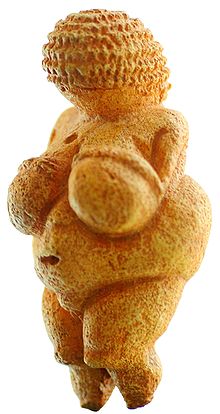
Hundreds of small female figurines — exaggerating breasts, hips, and abdomen — have been found across Europe and the Near East from the Gravettian period onward. The Venus of Willendorf (c. 25,000 BCE, Austria), the Venus of Laussel (c. 23,000 BCE, France), and dozens of Anatolian examples cluster around sites of communal activity. Their purpose is debated: fertility charm, ancestral deity, or self-representation. What is certain is that the female body as a locus of sacred power is the oldest continuous religious theme in human art — predating agriculture, writing, and all the pantheons on this timeline.
Britannica — Venus of Willendorf
c. 5,000 BCE · Sumer
Ninhursag — “Lady of the Sacred Mountain,” mother of the gods
Ninhursag (also Ki, Ninmah, Nintu) is one of the four Sumerian creator deities alongside An, Enlil, and Enki. She fashions humanity from clay in several creation narratives and is the divine mother of kings. Her association with cattle, milk, and the steppe links her directly to the pastoral economy of early Mesopotamia. The myth of Enki and Ninhursag describes a garden paradise (Dilmun) where she heals the wounds Enki inflicts on himself by eating her sacred plants — a text with structural echoes in the Eden narrative. In the Linear B tablets, no equivalent figure survives by name, but the Minoan evidence suggests a comparable sacred feminine presence in the Aegean Bronze Age.
Oxford ETCSL — Enki and Ninhursag
c. 3,000 BCE · Sumer
Nisaba — goddess of grain, writing, and accounting
Nisaba is the Sumerian goddess of grain, reeds, and — crucially — writing and accounting. Scribes invoked her at the opening of texts; the reed stylus was her instrument. Her dual role as grain goddess and goddess of literacy makes her a remarkable figure for a course that will later discuss the emergence of writing: she embodies the argument that writing and agriculture are not merely parallel developments but intimately connected, since the first texts are grain-ration records. She is a direct link between the foodways timeline and the mythology of intellectual life. Her Roman equivalent Ceres (grain) and her partial Greek equivalent Demeter both strip out the literary dimension, leaving only agriculture.
Oxford ETCSL — Hymn to Nisaba (Nisaba A)
c. 2,000 – 500 BCE · Anatolia (Phrygia) and later Rome
Cybele — the Great Mother from Anatolia to Rome
Cybele (the Phrygian “Great Mother”, Matar Kubileya) is the most direct descendant of the Anatolian goddess tradition in the western Mediterranean. Her cult centred on a sacred black stone (possibly a meteorite) at Pessinus; her consort Attis dies and is resurrected annually, mirroring the Dumuzi/Inanna and Adonis cycles. The Roman Senate formally adopted her cult in 204 BCE, importing her black stone to Rome as a war measure against Hannibal — a remarkable moment where a Neolithic Anatolian goddess tradition was conscripted into Roman imperial religion. She prefigures the Virgin Mary in significant iconographic respects.
Livius.org — Cybele
25,000 BCE
5,000 BCE
3,000 BCE
2,000 BCE
c. 6,000 – 1,400 BCE · Crete and the Aegean
The Minoan goddess complex — a feminine-centred religion? key question
Minoan Crete presents the most concentrated Bronze Age evidence for a goddess-centred religion in the Aegean. The Snake Goddess (c. 1,600 BCE, already illustrated above), the Mountain Mother on seal rings, the Poppy Goddess (associated with opium, ecstasy, and the underworld), and the female figures presiding over peak sanctuaries all suggest a religious world in which the dominant sacred figure is female. Marija Gimbutas’s influential but contested hypothesis argues that pre-Indo-European Europe was broadly matrilineal and goddess-worshipping, and that the arrival of Indo-European-speaking peoples (including proto-Greeks) imposed a sky-god patriarchal religion upon it. Whether or not one accepts Gimbutas, the contrast between the Minoan visual record and the male-dominated Linear B pantheon (Zeus, Poseidon, Ares…) requires explanation. At Akrotiri on Thera, the Xeste 3 fresco programme (buried c. 1,600 BCE) shows women gathering saffron and bringing it to a goddess enthroned above them, a griffin — collared, controlled — seated at her side: Aegean art has no fixed symbol for a god, but the leashed griffin comes closest, and kings later coveted the same power (griffins flanked the throne at Knossos).
Goodison & Morris, “Beyond the Great Mother” (critical reassessment) — search this title in JSTOR
Marinatos, Minoan Religion: Ritual, Image, and Symbol (Columbia, SC, 1993) — search this title in your library catalogue
c. 700 BCE · Hesiod, Theogony
Gaia, Rhea, Hera — the suppressed feminine in the Greek succession myth
Hesiod’s Theogony begins with Gaia (Earth) as the primordial generating force — she gives birth parthenogenetically, creates Ouranos (sky) as her own mate, and initiates the succession crisis by arming Kronos against his father. She is more powerful than any male deity in the poem’s cosmogony, yet by its end she is subordinated to Zeus. Rhea, the Titaness who saves Zeus, is structurally equivalent to Ninhursag (who saves the god of wisdom in Sumerian myth) and to Cybele (the Phrygian Great Mother). Hera, Zeus’s queen, retains the political power of the old goddess tradition but is systematically humiliated in Homer. The “patriarchal takeover” is not a modern feminist reading: it is inscribed in the structure of Hesiod’s own text — though it is an incorporation as much as a suppression: Zeus swallows Metis, cunning intelligence herself, so her wisdom becomes his own and Athena is born armed from his head; he marries Themis, whose daughters Eunomia, Dike, and Eirene (Good Order, Justice, Peace) are the terms on which his cosmos is finally ordered.
c. 650 BCE · Eleusis
Demeter and the Eleusinian Mysteries — the goddess who outlasts the Olympians
Demeter (whose name may mean “grain mother” — + mētēr) is the Olympian goddess closest to the old fertility goddess tradition. Her Eleusinian Mysteries — celebrated continuously for nearly 1,000 years — were the most important religious institution in classical Greece. Their content was secret, but their structure (descent, loss, return, renewal) mirrors the Inanna descent narrative. Initiates were promised a blessed afterlife: a promise not offered by standard Olympian religion. Demeter is also the direct link between this timeline and the foodways timeline: she is the grain itself, the agricultural cycle personified, the deity whose “holy fruits” Hesiod instructs his brother to harvest in due season. She survives the patriarchal Olympian settlement precisely because you cannot separate the goddess of grain from the grain.
Richardson, “The Eleusinian Mysteries” — search this title in JSTOR
Venus of Willendorf, c.25,000 BCE
Venus of Willendorf, c. 25,000 BCE. Naturhistorisches Museum, Vienna. The oldest religious image in the world with a possible goddess interpretation. Her anonymity — no face, no identity, only body — marks the difference between a personalised deity and a sacred force.
Wikimedia Commons (public domain)
Cognate chain — the feminine divine
Earth / mother: Ninhursag / Ki (Sumer) → Rhea (Greece) → Cybele (Phrygia/Rome) → Gaia (Hesiod)  |  Grain goddess: Nisaba (Sumer) → Isis (Egypt, grain aspect) → Demeter (Greece)  |  Love / fertility: Inanna → Ishtar → Astarte → Aphrodite  |  Underworld keeper: Ereshkigal (Sumer) → Persephone / Hecate (Greece)  |  War goddess: Anat (Ugarit) → Athena (Greece)  |  The triad: in both Canaanite and Greek traditions a group of three goddesses divides the feminine divine: love, war, and sovereignty. The Greek Hera/Athena/Aphrodite triad that judges Paris is the Asherah/Anat/Astarte triad of the Baal Cycle, one generation on.
Links: Foodways timeline ↔ Mythology timeline ↔ Gender & Family (later discussion) The grain goddess (Demeter/Nisaba/Inanna) is the theological expression of the agricultural system traced in the foodways timeline. She connects the two sets of material directly. Looking forward: the progressive marginalisation of goddess figures within the Greek Olympian pantheon — from Gaia’s sovereignty in the Theogony to Hera’s subjugation in Homer — is the mythological trace of real changes in gender relations, inheritance patterns, and religious authority that the later gender and family discussion will examine from the social and legal side.

Group Source-Analysis Activities

Three 45–60 minute activities, matched to the three cases at the centre of this week’s lecture, “Gods and Monsters.” Six groups of five students: two groups per task.

The central question: what can survive without a story?

Bronze Age Crete and Mycenaean Greece practised elaborate religion for at least a thousand years before Hesiod or Homer wrote a line about their gods. What survives from that world is not myth but material: a fresco, a grave, a set of administrative tablets. Each activity below pairs one such primary source with a scholarly argument built on top of it, and asks you to test how much weight that argument can actually bear.

The third activity is where this week’s material meets the older transmission question this timeline traces above: the succession myth Hesiod eventually wrote down has close structural relatives in Hatti and Ugarit, centuries older — and the Linear B tablets show that when those relatives were current, it was Poseidon, not Zeus, who was Mycenaean Greece’s most honoured god.

1
Observe10 min — read both sources separately
2
Compare10 min — map what each source can and can’t show
3
Infer10 min — what does the scholarly argument add?
4
Extend10 min (whole class) — how far does the evidence actually reach?
A
45–60 min  ·  Groups of 5  ·  The oldest goddesses
One Goddess, or Many? The Xeste 3 Frescoes and the “Great Goddess” Debate
Click to expand ▼
▶ PRIMARY SOURCE
The Xeste 3 fresco programme, Akrotiri, Thera  ·  buried c. 1,600 BCE

On the ground floor of a three-storey house at Akrotiri, a sunken room was painted with three women: one holds out a necklace, one sits bleeding from the foot, one comes veiled toward horns of consecration from which blood also runs. Directly above, women in flounced skirts gather saffron and bring it to a goddess seated on a raised platform — larger than the other figures, elevated, attended by a griffin and a monkey holding up the crop. No inscription names her: scale, elevation, and what is brought to her are the only signs of divinity Aegean art gives us.

Doumas, The Wall-Paintings of Thera (Athens, 1992); Vlachopoulos, “Images of Physis or Perceptions of Metaphysis?”, in Metaphysis (Aegaeum 39, 2016): 375–86 — search these titles in your library catalogue
▶ SCHOLARLY ARGUMENT
Nanno Marinatos, against a single “Minoan Great Goddess”  ·  Minoan Religion, 1993

Where Arthur Evans, and later popularisers influenced by Marija Gimbutas, assumed one universal Mother Goddess behind every female image on Bronze Age Crete, Marinatos argues for several distinct goddesses tied to specific places and rites — a peak-sanctuary goddess, a funerary goddess, a palace goddess — identified by context rather than by a shared essence. Goodison and Morris’s Ancient Goddesses (1998) surveys the same debate from several angles without settling it.

Goodison & Morris (eds.), Ancient Goddesses: The Myths and the Evidence (British Museum Press, 1998) — search this title in JSTOR / your library catalogue
Stage 1 — Observe (10 min)
Describe the Xeste 3 programme floor by floor: the three women below, the saffron-gatherers and enthroned figure above. Which figure is marked as divine, and by what visual signal — not a name, since none survives?

Stage 2 — Compare (10 min)
Set this fresco beside the Snake Goddess, Mountain Mother, and Poppy Goddess named in this timeline’s Minoan-goddess entry above. Is the Xeste 3 goddess the same figure under a different guise, a different goddess entirely, or is that even a question images alone can answer?

Stage 3 — Infer (10 min)
Read Marinatos’s argument against a single universal Great Goddess. What kind of evidence would decide between “one goddess, many guises” and “several distinct goddesses”? Is this a question the archaeological record can settle at all without a legible text?
3-minute report to class State whether your group leans toward one goddess or several, and name the single piece of evidence that most shaped that view.
Stage 4 — Extended Discussion (after break  ·  10 min, whole class)

Bring in what Task B finds about the Griffin Warrior’s grave:

  • “Great Goddess” already assumes an answer. Marinatos avoids the capitalised phrase, describing separate ritual contexts instead. Does dropping it change how you read the Xeste 3 scene?
  • No Linear A text can be read. Every claim here rests on images and find-spots, with no divine name attached to any of them. What kind of claim can archaeology support without a legible text — and what kind can it not?
  • The same leashed griffin that attends the Xeste 3 goddess turns up two centuries later on rings buried with a Mycenaean man (Task B). Does imagery crossing that freely between gender and geography support Marinatos’s plural-goddess reading, or does it just show that meanings travel loosely regardless of how many goddesses there originally were?

Aim for one class statement: “The Minoan evidence supports _____ about female divinity, and cannot decide _____.”

Further Reading (for your own time)

Accessible: Doumas, C. The Wall-Paintings of Thera (Thera Foundation, Athens, 1992). The fullest photographic publication of the Xeste 3 programme; widely held in university libraries.

Peer-reviewed: Marinatos, N. Minoan Religion: Ritual, Image, and Symbol (University of South Carolina Press, 1993). The standard argument against a single universal Minoan goddess.
Dubcóva, V. “Mastering a Griffin: The Agency and Perception of Near Eastern Images by the Aegean Bronze Age Elite,” Anodos 13 (2013, publ. 2019): 163–78 — search this title in JSTOR

B
45–60 min  ·  Groups of 5  ·  The Griffin Warrior
A King Before the Word “King”: Reading the Griffin Warrior’s Grave
Click to expand ▼
▶ PRIMARY SOURCE
The Griffin Warrior’s grave, Pylos  ·  excavated 2015, buried c. 1,450 BCE

An un-robbed shaft grave held a man of about thirty-five, buried with bronze armour, a boar’s-tusk helmet, a gold-pommelled sword, four gold signet rings, and more than fifty engraved seal-stones. Three of his four rings show goddesses, none shows a man. His weapons lay on his left side; his rings and seals lay on his right, as if the mundane and the divine were deliberately kept apart. He was buried at least two centuries before the first Linear B tablet uses the word wanax, “king.”

Davis & Stocker, “The Lord of the Gold Rings: The Griffin Warrior of Pylos,” Hesperia 85 (2016): 627–55 — search this title in JSTOR
▶ SCHOLARLY ARGUMENT
Stocker & Davis, “An Early Mycenaean Wanax at Pylos?”  ·  2020

The excavators argue that the Griffin Warrior may represent an early form of the office later written wanax — his command of Minoan-derived religious imagery (the genii, the sun-disks, the leashed griffin) functioning as a display of authority centuries before any tablet records the title. The argument rests entirely on grave goods: no text names him or his rank.

Stocker & Davis, “An Early Mycenaean Wanax at Pylos? On Genii and Sun-Disks from the Grave of the Griffin Warrior,” in Blakolmer (ed.), Current Approaches and New Perspectives in Aegean Iconography (Aegis 18, 2020): 293–300 — search this title in your library catalogue
Stage 1 — Observe (10 min)
Catalogue the grave’s contents and their placement. What might separating weapons (left) from rings and seals (right) suggest about how these two categories of object were understood?

Stage 2 — Compare (10 min)
Compare the ring imagery here with the Xeste 3 goddess from Task A. Is this the same Minoan religious world simply transplanted to a Mycenaean grave, or a mainland reappropriation of Cretan images for different ends?

Stage 3 — Infer (10 min)
Assess Stocker and Davis’s “early wanax” argument. What would it take for grave goods alone to demonstrate political office, as against religious status, wealth, or personal preference? Can these even be separated in a Bronze Age burial?
3-minute report to class State whether your group would call the Griffin Warrior “a king,” “a priest,” “a warrior with a taste for foreign luxury,” or would refuse the question — and why.
Stage 4 — Extended Discussion (after break  ·  10 min, whole class)

Bring in what Task A found about the Xeste 3 goddess:

  • Wanax does not appear in writing for at least two centuries after this burial. Does its absence mean the office did not yet exist, or only that we cannot yet see it in writing?
  • None of the four rings shows a man. What does a Mycenaean man buried wielding exclusively goddess imagery suggest about early Mycenaean kingship’s relationship to religious authority?
  • The Combat Agate, one of his seal-stones, engraves a duel with anatomical detail unmatched in Greek art for a thousand years — on a stone 3.5 cm across. What does a society choose to spend that level of skill on, and what does the choice reveal that a written record would not?

Aim for one class statement: “The Griffin Warrior’s grave supports _____ about early Mycenaean power, and the missing word wanax adds _____.”

Further Reading (for your own time)

Accessible: the 2015 discovery received wide press coverage at the time of excavation (University of Cincinnati, the excavating institution, is the best starting point).
search “Griffin Warrior Pylos discovery” via your library’s news database

Peer-reviewed: Davis & Stocker, Hesperia 85 (2016): 627–55; Stocker & Davis, “The Combat Agate from the Grave of the Griffin Warrior at Pylos,” Hesperia 86 (2017): 583–605; Stocker, McNamee, Vitale, Karkanas & Davis, “The Grave of the Griffin Warrior at Pylos: Construction, Burial, and Aftermath,” Hesperia 91 (2022): 211–50.
search these titles in JSTOR

C
45–60 min  ·  Groups of 5  ·  The rise of Zeus
The Rise of Zeus — an Administrative Record and a Literary One
Click to expand ▼
▶ PRIMARY SOURCE
Linear B tablets: Poseidon’s dossier  ·  c. 1,400–1,200 BCE

KN V 52 (c. 1400 BCE) records the earliest readable Greek god-names; PY Un 718 and PY Tn 316 show Poseidon receiving a feast that fed hundreds, a consort (Posidaeia), and land held in his name; two cult epithets (Srapedas, Ennosidas) give him the fullest profile of any Mycenaean god. Zeus, by contrast, appears at Knossos with a single, geographically specific epithet — Zeus Diktaios (KN Fp 1) — tied to one sacred mountain. No Linear B tablet connects Poseidon with the sea.

Palaima, “Sacrificial Feasting in the Linear B Documents,” Hesperia 73 (2004): 217–46 — search this title in JSTOR
▶ LITERARY TEXT
Hesiod, Theogony: Zeus’s succession  ·  c. 700 BCE

Five centuries after those tablets, Hesiod makes Zeus king through a succession fought in the same structure this timeline traces from Kumarbi and Baal above — but the Greek version resolves differently: Zeus swallows Metis so her cunning becomes his own, and marries Themis, whose daughters Eunomia, Dike, and Eirene set the terms of his order. In the Iliad, Poseidon still claims equal rank to Zeus by an ancient lot dividing sky, sea, and underworld among three brothers, and yields only “under protest.”

Theoi.com — Hesiod Theogony, full text
Stage 1 — Observe (10 min)
Lay out what the Linear B tablets say about Poseidon and Zeus side by side (feasts, epithets, land, consort). Which god has the stronger Bronze Age administrative record?

Stage 2 — Compare (10 min)
Set Hesiod’s succession myth beside the Kumarbi Cycle and Baal Cycle mapped earlier in this timeline. Where is the parallel closest (the castration, the swallowing)? Where does the Greek version diverge (Metis, Themis)?

Stage 3 — Infer (10 min)
Put the two findings together. If Poseidon was Mycenaean Greece’s leading god, and the myth that makes Zeus king is a later, partly imported story, what actually changed between the Bronze Age collapse and Hesiod — and how much of that change can this evidence actually explain?
3-minute report to class State the single strongest piece of evidence for Poseidon’s Bronze Age priority, and the single most exact parallel between Hesiod and his Near Eastern predecessors.
Stage 4 — Extended Discussion (after break  ·  10 min, whole class)

Bring together all three of today’s tasks:

  • Zeus carries the older name — Diwos, from Proto-Indo-European Dyēus — even though Poseidon has the stronger Bronze Age cult record. What does it mean for a god to have linguistic seniority but administrative junior status?
  • No eastern king-god — Marduk, Teshub, Baal — is challenged by his own brothers after taking the throne. Poseidon’s claim to equal rank, and his protest, has no eastern parallel. Is this a demotion of Poseidon in the later myth, or a trace of genuine Bronze Age priority surviving into it?
  • A fresco, a grave, and a set of tablets: none of today’s three primary sources is a story. What can each kind of evidence tell us about Bronze Age religion that a myth cannot — and what does each conceal that only a story could supply?

Aim for one class statement: “The rise of Zeus, on this evidence, looks like _____ rather than a straightforward inheritance from the Bronze Age.”

Further Reading (for your own time)

Accessible: Palaima, T.G. “Mycenaean Religion.” In Shelmerdine (ed.), The Cambridge Companion to the Aegean Bronze Age (Cambridge, 2008): 342–61. A readable overview of the evidence for both gods; check your library.

Peer-reviewed: Hoffner, H.A. Hittite Myths, 2nd ed. (Society of Biblical Literature, 1998) — translations of the Kumarbi Cycle; Smith, M.S. The Ugaritic Baal Cycle, 2 vols (Brill, 1994–2009).
search these titles in your library catalogue