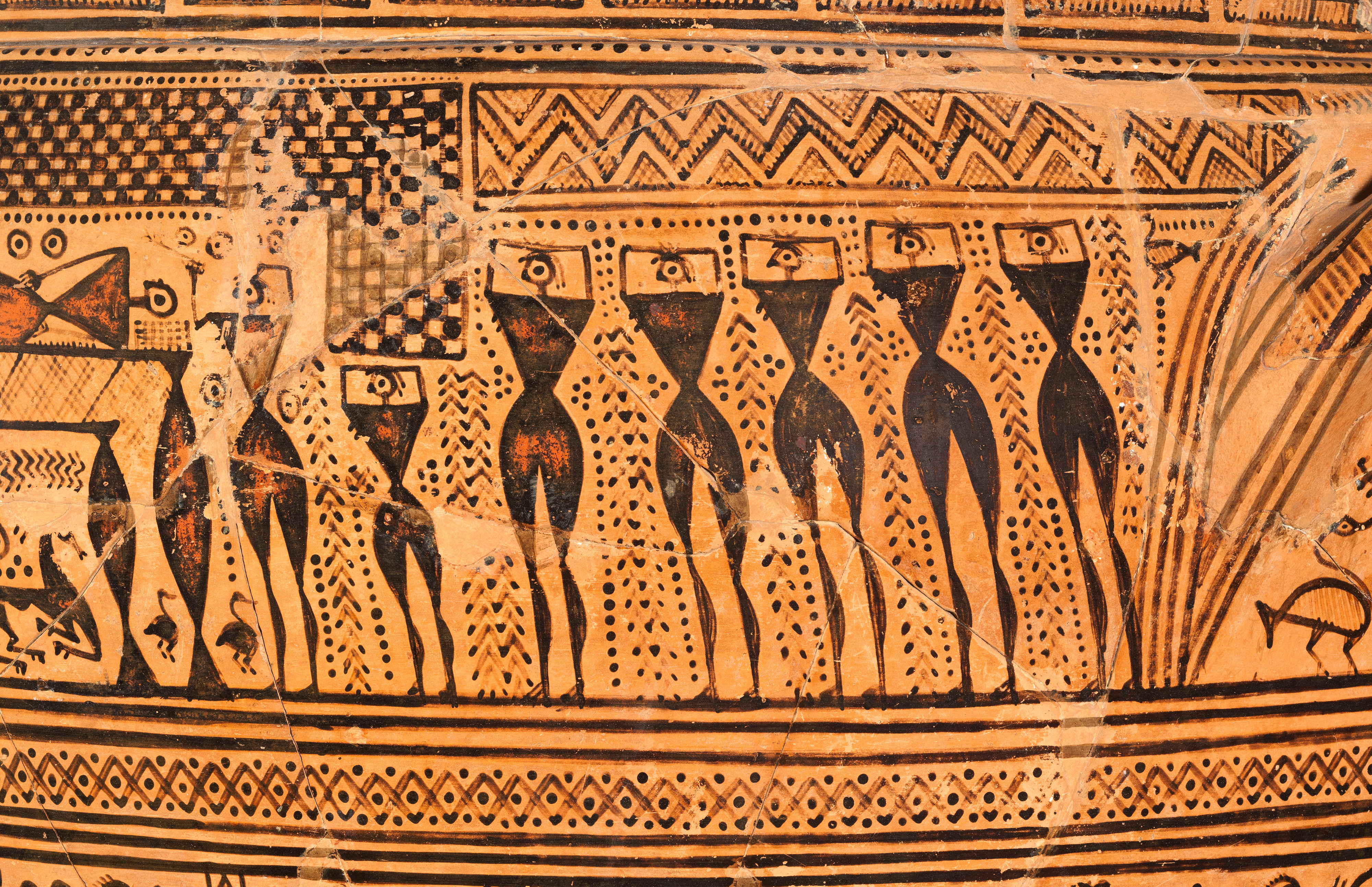
The pregnant woman’s cremation Lecture evidence
Liston and Papadopoulos · Hesperia 73 (2004), 7–38
HIST 304: Greek Civilization · Stephenson · greekciv.com
Women, gender, and the construction of the feminine in the ancient Greek world
A parallel timeline tracing the roles assigned to, performed by, and imposed on women across the Greek world from the Bronze Age to Alexander. The thread begins with the great goddesses whose theological inheritance shapes every human role that follows. It moves through the archaic and classical periods via women as mourners, as wives and mothers within the oikos, and as hetairai and pornai in the spaces men constructed outside it. This is an exercise in reading absence: most of our evidence is made by men, for men, about women. Reading against the grain of that evidence is the central methodological skill the timeline practises. The title deliberately rearranges the categories of Sarah Pomeroy’s foundational study Goddesses, Whores, Wives, and Slaves (1975) — the text that put ancient women permanently on the scholarly agenda — to foreground the sacred and maternal alongside the erotic and conjugal, and to keep the question of how we name and order these categories open from the start.
Two tasks, each about twenty minutes in pairs. Each ends with one short paragraph. Use the evidence supplied here and the revised lecture; the wider timeline remains available for reference.
Compare the lecture’s opening and closing objects. Begin with what each image makes visible.
Attic Geometric krater · c. 750–735 BCE
Apulian volute krater · 360–340 BCE

Keep in view: women’s organised lament helps present the dead man to the living. Persephone receives the dead as a ruler, although her marriage began with an agreement between Zeus and Hades. The Pelinna leaves give a deceased woman words with which to approach her. Neither vase establishes how much freedom mortal women enjoyed.
Discuss: what changes when women performing a funeral are compared with a goddess who receives the dead? Identify one visible gesture or compositional feature in each image before using the lecture to interpret it.
Write together: about 100 words comparing the two roles. Use one detail from each vessel and finish by identifying one question about women’s lives that these images cannot answer.
The following summaries paraphrase the prosecution in Against Neaira, delivered around 340 BCE. Apollodoros speaks to male jurors; Neaira’s own account does not survive.
§§18–19 · Purchase and earnings
The speaker says Nikarete, a freedwoman, purchased seven girls and trained them for sexual commerce. Calling them her daughters allowed her to present enslaved girls as free and charge customers higher fees. She received the income and later sold them.
§§29–32 · Buying freedom
Two clients bought Neaira for thirty minae. When they planned to marry, they offered release for twenty, provided she no longer practised in Corinth. She assembled contributions and money of her own; Phrynion supplied the balance. The terms were set by her owners.
Read the original translation, §§18–19 and 29–32 if you want to check the wording.
Discuss: does describing Neaira as a hetaira explain who controlled her labour? Compare ownership, earnings and the conditions of release. Distinguish what the prosecutor recounts from what we can independently establish.
Write together: 80–100 words answering the title question. Support your answer with one transaction and one condition imposed on Neaira. End with one limitation of the prosecution as evidence.
These references support further study and are not additional tasks. Library or borrowing access may be required.
Loraux, N. The Mourning Voice: An Essay on Greek Tragedy (Cornell, 2002) — on the gendering of lamentation in tragedy as well as funerary art.
Stears, K. “Dead Women’s Society: Constructing Female Gender in Classical Athenian Funerary Sculpture,” in Time, Tradition and Society in Greek Archaeology (1995) — open access, IWU Digital Commons
Pomeroy, S. Xenophon: Oeconomicus — A Social and Historical Commentary (Oxford, 1994) — the standard scholarly commentary; explains the historical context of every passage.
Cohen, D. “Seclusion, Separation, and the Status of Women in Classical Athens,” Greece and Rome 36 (1989), pp. 3–15 — argues that seclusion was more ideological than actual; good counterpoint to Xenophon.
Hamel, D. Trying Neaira: The True Story of a Courtesan’s Scandalous Life in Ancient Greece (Yale, 2003) — accessible scholarly narrative; uses the speech to reconstruct Neaira’s biography critically.
Davidson, J. Courtesans and Fishcakes: The Consuming Passions of Classical Athens (HarperCollins, 1997) — wider context for the hetaira economy; useful background for the symposium iconography.
Kapparis, K. Apollodoros ‘Against Neaira’ [D.59] (de Gruyter, 1999) — full commentary on the speech; essential for advanced engagement with the legal arguments.
Carson, A. If Not, Winter: Fragments of Sappho (Vintage, 2002) — the standard translation; the introduction on the brackets and transmission is essential reading for further study. Internet Archive (open access).
Lardinois, A. “Who Sang Sappho’s Songs?” in Greene, E. (ed.) Reading Sappho: Contemporary Approaches (California, 1996) — on the thiasos and performance context.
Rayor, D. & Lardinois, A. Sappho: A New Translation of the Complete Works (Cambridge University Press, 2014) — includes the 2014 Brothers poem with full scholarly introduction.
Burris, S., Fish, J. and Obbink, D., “New Fragments of Book 1 of Sappho”, ZPE 189 (2014), 1–28. For the provenance controversy read C. Michael Sampson, “Deconstructing the Provenances of P.Sapph.Obbink”, BASP 57 (2020), 143–169, and the 2021 retraction notice. Retraction of the provenance account is distinct from proof of forgery.
Additional source access
General Reading — for the whole course unit on women and gender
Pomeroy, S.B. (ed.) Women’s History and Ancient History (University of North Carolina Press, 1991) — the collected volume that includes the Snyder essay on Sappho cited above, alongside foundational essays on Greek and Roman women across the full chronological range of the course. Essential background reading for the entire gender unit. UMD library access (JSTOR proxy)