Burnt bone on a mountain, painted marble on the Acropolis and the words of a captive woman preserve different parts of Greek religious life. Follow these traces through sanctuaries, festivals and the work needed to prepare them. The parallel timeline places the Greek material beside selected comparisons from Egypt and western Asia.
Week 13 discussion. Gold callouts connect the timeline with the six sections of the lecture. The final section supplies wider background on sacred kingship.
Temple / cult / architecture
Oracle / prophecy
Panhellenic sanctuary
Theatre / drama / Dionysus
Games / competition
Near Eastern comparator
Sacred kingship
Wider comparisonsEgypt · western Asia · Greek themes
date
The Greek worldAegean · Mediterranean · Hellenistic kingdoms
Bronze Age sacred foundationsc. 2100–800 BCE
↔
Buildings, rites and the evidence between them. The parallel columns place Greek sites beside selected examples from Egypt and western Asia. Their dates often differ because the comparison follows practices as well as contemporary contacts. Stone, ash, bone, inscriptions and literary accounts preserve different parts of a sanctuary’s history. The Greek sequence begins with palace records and sacrificial deposits before following the development of larger buildings.
c. 2100 BCE · Ur, Mesopotamia
Ur: a tower within Nanna’s precinct
Ur-Namma’s ziggurat rose within the sacred precinct of Nanna, the moon god. Its surviving lower stages reveal the large quantities of mudbrick, baked brick and labour needed to maintain a major sanctuary. The tower belonged to a wider complex of buildings, courtyards and stores supported by royal patronage. Temples elsewhere in Mesopotamia took other forms. Ur provides a particular comparison for Greek sanctuaries: a god’s dwelling required land, supplies, workers and institutions able to bring those resources together.
c. 1500 BCE onward · Thebes, Egypt
Karnak and Luxor: building and procession
At Thebes, successive rulers enlarged the temple complexes of Amun over many centuries. Pylons, courts and columned halls marked different stages of access, while festival processions carried divine images beyond their customary resting places. The Great Hypostyle Hall at Karnak belongs principally to the nineteenth dynasty, later than the early New Kingdom buildings. These changing complexes combine restricted interiors with routes along which larger populations could encounter a festival. Access depended on occasion, office and location within the precinct.
c. 2100 BCEc. 1500 BCE onwardc. 1600–1200 BCELate Bronze Age–early Iron Age
c. 1600–1200 BCE · Mycenaean Greece
Palace halls and the names of gods
Mycenaean palaces contained large halls with central hearths, columns and adjoining rooms. Their architecture accommodated royal reception and ceremonial activity, while Linear B tablets recorded offerings to gods whose names include Zeus, Poseidon and Dionysus. Cult also occupied spaces beyond the central palace hall. The destruction of the palaces around the end of the Bronze Age disrupted the institutions producing those records. Buildings, divine names and practices therefore offer different kinds of evidence when tracing connections with later Greek religion.DAMØS · Linear B database
Late Bronze Age–early Iron Age · Mount Lykaion
Burnt bone on an Arcadian summit
Excavation at the ash altar of Zeus on Mount Lykaion has recovered burnt animal bone from deposits extending into the Late Bronze Age. Radiocarbon dates establish a chronology for samples, while microscopic study of the deposits helps distinguish burning and the accumulation of ash. This evidence gives a local history of repeated sacrificial activity before the large stone temples familiar from later sanctuaries. Continuity needs to be established through a site’s deposits and practices; it cannot be inferred from the survival of a divine name alone.
◆
Lecture §1 · The altar and the god’s house. The burnt bone and ash on Mount Lykaion establish a local history of sacrifice. Amarynthos adds rooms, hearths and vessels to the study of an early sanctuary.
Panhellenic sanctuariesNinth–sixth centuries BCE
↔
Journeys made a sanctuary’s wider community. Roads and sea routes brought competitors, enquirers, spectators and offerings to places beyond their home cities. Visitors still entered sanctuaries managed by particular authorities. The map distinguishes the four crown festivals from Athens and Epidauros, two further centres in the lecture. Open the site notes beneath it for the relevant gods, contests and buildings.
Sacred geography
Four crown festivals and two further centres from the lecture
Purple: the four crown festivals. Gold: Athens and Epidauros. The numbers link the map with the notes below; open any note for its context.
1 · Olympia — Zeus · Olympic Games
The traditional victor list begins in 776 BCE. Sacrifices and contests drew visitors to Elis; the truce protected the festival and connected journeys. The sanctuary contained temples, altars, treasuries, training facilities and dedications.
2 · Delphi — Apollo · Pythian Games
Consultation of the Pythia shared the sanctuary with dedications and festival competition. The Pythian programme included musical and athletic contests, with its principal celebration every four years.
3 · Isthmia — Poseidon · Isthmian Games
Near Corinth, the sanctuary of Poseidon hosted a crown festival every two years. Its location at the Isthmus connected overland travel with the routes of the two gulfs.
4 · Nemea — Zeus · Nemean Games
The Nemean festival, conventionally dated from 573 BCE, honoured Zeus and formed part of the crown circuit. Its principal contests occurred every two years.
5 · Athens — Athena and Dionysus · civic festivals
Athens hosted the Panathenaia and dramatic festivals of Dionysus. The Acropolis and Theatre of Dionysus occupied related parts of the city’s religious landscape, with distinct rites and programmes.
6 · Epidauros — Asklepios · healing sanctuary and theatre
The theatre belonged to a sanctuary receiving people seeking healing. Its lower auditorium dates to the fourth century BCE and its upper extension to the Hellenistic period. Acoustic findings concern these particular architectural phases and performance conditions.
Continuous regional coastline (1:50 million): Natural Earth / World Atlas. The surrounding land is included without modern political borders; some small islands and local detail are omitted at this scale.
First millennium BCE · Wider comparisons
Sanctuaries serving several communities
Nippur’s sanctuary of Enlil attracted the patronage of rulers from different Mesopotamian cities, while Jerusalem’s temple acquired its own changing political and regional importance. Greek sanctuaries also drew visitors and offerings across civic boundaries. Their administration remained attached to particular communities and institutions: Elis controlled Olympia, and the Amphictyony had responsibilities at Delphi. The reach of a sanctuary and the distribution of authority within it need to be considered together, including disputes over access, revenue and control.
First millennium BCEEighth century BCE onward776 BCE: traditional first victory
Eighth century BCE onward · Delphi
Apollo’s oracle and the work of consultation
Visitors came to Delphi with enquiries, gifts and the resources needed for a journey into central Greece. The Pythia delivered Apollo’s responses within a sanctuary staffed by other religious officials. Springs, purification and the arrangements for consultation placed the oracle within a sequence of ritual actions. Ancient descriptions and modern geological investigations have encouraged explanations involving gases, but the findings do not establish one chemical cause for all reported prophetic behaviour. The consultations are better documented than the physiological condition of each priestess.Delphi · historical gazetteer entry
776 BCE: traditional first victory · Olympia
A festival of Zeus and protected travel
The traditional list of Olympic victors begins in 776 BCE; this date gives the competition a remembered chronology rather than an archaeological foundation year for the sanctuary. Athletes, spectators and delegations gathered for sacrifice and contests in honour of Zeus. The sacred truce protected the festival and travel connected with it. Warfare continued elsewhere. Pausanias’ much later description of Zeus’s ash altar shows how accumulated sacrificial remains could themselves form a conspicuous monument within the sanctuary.
Apollo from the west pediment of Zeus’s temple at Olympia, c. 460 BCE: modern plaster cast in Munich. The original pedimental sculptures are in the Archaeological Museum of Olympia. Apollo stood amid the fighting of Lapiths and centaurs. This cast makes his posture available for study; its white surface does not preserve the ancient sculpture’s original colour.
Apollo’s sanctuary at Delphi. The terraces carried buildings and dedications beside routes used by visitors. The surviving remains belong to several periods of construction, damage and rebuilding, providing a landscape through which consultation, festival competition and the commemoration of donors can be followed.
Lecture §2 · Sanctuaries, journeys and initiation. The lecture follows consultation at Delphi and the journey to Eleusis. At Eleusis, purification, fasting, the procession and admission to the Telesterion formed stages of initiation. Experimental work shows that processing ergot can alter its alkaloids; the ancient drink’s ingredients remain unestablished.
Building the god’s houseLate eighth–early fifth centuries BCE
Late eighth century BCE onward · Greek sanctuaries
Hearths, rooms and colonnades
The early temple of Artemis at Amarynthos on Euboea, about thirty-two metres long, contained several rooms and three hearths. Its late eighth-century remains give substantial architecture and interior ritual activity a place in the history of early sanctuaries. Surrounding colonnades developed in different local settings and helped organise movement, shelter and the appearance of buildings. The altar often occupied an open space beside a temple, while the uses of rooms inside depended on the sanctuary and the rites performed there.
Late eighth century BCE onwardc. 590 BCEc. 540–500 BCE
c. 590 BCE · Olympia
Hera’s temple and successive repairs
The temple of Hera at Olympia combined stone foundations with other materials, including wooden columns that were gradually replaced in stone. The differences between surviving capitals preserve part of that history of repair. A sanctuary’s buildings changed through use, damage and renewal. The statue of Hermes carrying the infant Dionysus was found in the temple in 1877 and is now displayed in the Archaeological Museum of Olympia. Its later presence also shows how a building could receive objects long after its construction.
c. 540–500 BCE · Corinth and Aegina
Stone columns and sculpted pediments
Seven monolithic columns of Apollo’s temple still stand at Corinth, giving a partial measure of its sixth-century construction. At Aphaia’s sanctuary on Aegina, the temple built around 500 BCE carried sculpted scenes of warfare associated with Troy. The west pediment’s figures generally belong to an earlier sculptural phase than those of the east. The comparison follows decisions about stone, posture and the disposition of bodies within a triangular space, including work and replacement undertaken at different dates.
Classical sanctuariesFifth century BCE
c. 435 BCE · Olympia
Pheidias’ seated Zeus
Pausanias describes the seated image of Zeus made by Pheidias in gold and ivory, with a throne bearing elaborate decoration. The statue occupied the temple built several decades earlier, adding another expensive commission to a sanctuary already filled with offerings. Its materials required specialised work and continuing care. Visitors encountered the god through the image, the building, sacrifices and other monuments around it. The fame of the statue also travelled through descriptions and representations beyond Olympia itself.Pausanias 5.11 · the image of Zeus
c. 435 BCE447–432 BCE421–406 BCE
447–432 BCE · Athens
The Parthenon and the resources of Athens
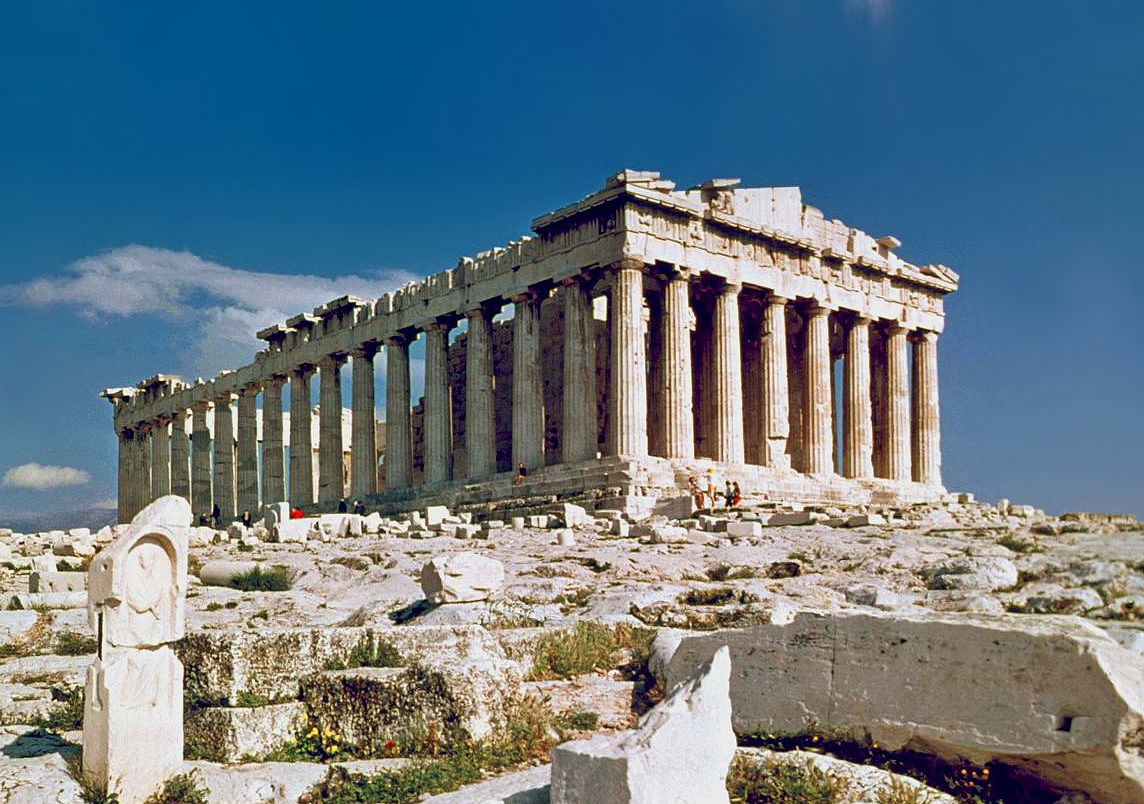
Construction of the Parthenon began in 447 BCE; the building and Athena’s image were dedicated in 438, while sculptural work continued. Accounts record expenditure within an Acropolis programme drawing on the resources of an imperial city. Sculptors placed battles in the metopes, divine narratives in the pediments, and a procession with seated gods in the frieze. Traces of pigments now recover details lost from the weathered marble, including patterns on clothing. Task A connects this material evidence with an account of paid work on another Acropolis temple.British Museum · Parthenon sculptures
The Parthenon, Athens, begun 447 BCE. Its columns and platform incorporate measured curves and inclinations, with individual stones cut for their places in the building. The surviving marble also bears traces of painted decoration. Construction, carving and painting required successive kinds of work before the monument entered its continuing history of use and repair.
The building now called the Erechtheion accommodated cults and sacred places on different levels of the Acropolis. Athena Polias, Poseidon-Erechtheus and other local traditions had claims within and around this restricted area. Its irregular plan records the demands of place and worship as well as architectural design. Building accounts preserve payments for particular tasks and identify workers of different legal standing. The amounts paid for column fluting in 408/7 BCE bring skilled labour and ownership into the history of the sanctuary.
◆
Lecture §4 · The rock of Athena. Pigment imaging recovers painted surfaces on the Acropolis. Building accounts identify particular workers and payments. Task A brings these two forms of evidence together.
Theatre and DionysusSixth–fourth centuries BCE
↔
A festival required preparation. The Athenian dramatic competitions combined worship of Dionysus with rehearsals, sponsorship, judging and performance. The texts survive more fully than the music, movement and temporary structures through which audiences encountered them. The following cards place individual plays within that working festival and the circumstances of their production.
Second millennium BCE onward · Egypt and western Asia
Ritual action and later reconstructions of drama
Egyptian texts and monuments record processions and ritual actions associated with Osiris at Abydos; Babylonian festivals also brought images, officials and participants into arranged sequences of movement. These materials document performed rites, although modern reconstructions of a complete ancient “passion play” go beyond what every source preserves. Greek dramatic competition developed in its own festival institutions. Dionysus already appears in Mycenaean records, making his later association with theatre part of a longer and varied history of worship.
416 BCE setting · Fourth-century text
Agathon’s victory and Plato’s drinking party
Plato sets the Symposium after Agathon’s dramatic victory in 416 BCE. The guests’ speeches on love unfold in a household celebration linked to a public festival. Written in the fourth century, the dialogue gives that earlier occasion a philosophical and literary form. Its exchanges place poets, politicians and philosophers in conversation, while the arrival of Alcibiades changes the proceedings. It supplies evidence for the uses of dramatic fame and remembered social encounters rather than a transcript of Athenian opinion.
Second millennium BCE onward416 BCE setting534 BCE: traditional date458 BCEc. 441 BCE and later fifth century431 and 415 BCE425 and 411 BCE
534 BCE: traditional date · Athens
Thespis and the remembered beginnings of tragedy
Later traditions associated Thespis with an early tragic victory at Athens in 534 BCE, during the tyranny of Peisistratos. The date offers a conventional starting point for a history whose early performances are poorly documented. By the fifth century, tragedy formed part of organised competitions at festivals of Dionysus, with poets, actors and choruses preparing productions for judgement. Officials and wealthy sponsors had defined responsibilities, while the preparation and performance required work extending well beyond the days of the festival.
458 BCE · Athens
The Oresteia: judgement and continuing cult
Aeschylus’ trilogy follows murder and retaliation within the house of Atreus through to the trial of Orestes at Athens. Athena establishes a court in the drama, while the pursuing Furies must be persuaded to accept a place and honours in the city. The settlement includes continuing worship of these powers. The performance brings a heroic family’s violence into a story about civic judgement and the accommodation of divine claims. It belongs beside the contemporary institutions and cults through which its audience understood the city.Aeschylus · Agamemnon
c. 441 BCE and later fifth century · Athens
Sophocles: burial, authority and knowledge
In Antigone, Creon’s prohibition on the burial of Polyneices brings his authority into conflict with Antigone’s obligations to her brother and the dead. The consequences develop through decisions made within a particular ruling household. Oedipus Tyrannus, whose exact date is uncertain, follows an enquiry into a pollution afflicting Thebes. Both plays give divine requirements and human judgement a place in civic catastrophe. Their dramatic conflicts should be read through what characters know, do and suffer over the course of the performance.Sophocles · Antigone
431 and 415 BCE · Athens
Euripides: the household after violence
Medea, performed in 431 BCE, follows the destruction of a household through the actions of a woman threatened with exile. Trojan Women, performed in 415, places defeated women at the disposal of their Greek captors. The death of Astyanax gives the destruction of Troy a child’s body, a grandmother and a burial. Athenian violence at Melos in 416 provides a contemporary comparison, although the play’s meaning cannot be reduced to a documented response to that event. Task B supplies both passages.Euripides · Medea
425 and 411 BCE · Athens
Comedy during the Peloponnesian War
Aristophanes’ Acharnians follows a citizen’s private peace amid the war, while Lysistrata places women at the centre of a comic effort to compel the men to end fighting. The latter was performed in 411 BCE, after the Sicilian expedition had ended in catastrophe in 413. Festival comedy used invented situations, obscenity and recognisable public figures to address its audience. Its female characters give particular dramatic form to household and civic concerns; their speeches require interpretation within the conventions of comedy.Aristophanes · Lysistrata
The Theatre of Dionysus, Athens. The visible stone remains include substantial fourth-century and later work. Audiences faced towards the orchestra and stage area on the southern slope of the Acropolis. The Parthenon stood behind and above the auditorium, rather than forming a backdrop above the stage. Fifth-century plays therefore require attention to an earlier performance space as well as to the surviving theatre.
The theatre at Epidauros. The lower auditorium was built in the fourth century BCE and enlarged above in the Hellenistic period. Measurements and models examine direct sound, reflections and diffraction at the seats. Audience occupation and stage structures change the acoustic conditions. The theatre formed part of a sanctuary receiving visitors seeking healing, alongside other buildings used for ritual and care.
Photograph: Gregor Schöffl · unrestricted free use as recorded on the file page. Image record and reuse terms. Shown without cropping.
◆
Lecture §5 · The theatre of Dionysus. The fifth-century dramatic festivals preceded much of the stone theatre visible today. Acoustic studies investigate how voices, surfaces, scenery and audiences affected particular performance spaces. The theatre’s orientation does not put the Parthenon above the stage in the audience’s view.
Games and the competing bodyEighth–fourth centuries BCE
Second millennium BCE · Egypt and Mesopotamia
Wrestling and the display of strength
The wrestling scenes painted in Middle Kingdom tombs at Beni Hasan preserve sequences of holds and bodily movement. Mesopotamian narratives also made physical strength and contest part of heroic action, including the encounter between Gilgamesh and Enkidu. Such evidence places Greek athletics within a wider history of training, competition and the representation of powerful bodies. The organisation of contests, the people entitled to enter, and the rewards attached to victory give each setting its particular social and religious form.
Second millennium BCEEighth–sixth centuries BCE476 BCE
Eighth–sixth centuries BCE · Four sanctuaries
The four crown festivals
Olympia and Delphi held their principal games at four-year intervals; the Isthmian and Nemean games occurred every two years. The reorganised Pythian and Isthmian festivals belong to the early sixth century, with the Nemean games conventionally dated from 573 BCE. Athletes could travel between these festivals and compete for wreaths, reputation and honours at home. Foundation stories connected contests with gods and heroic deaths. Their schedules and local administration made the circuit possible without placing all four sanctuaries under one authority.
476 BCE · Olympia and Syracuse
Pindar’s first Olympian ode
Pindar’s first Olympian ode celebrates Hieron of Syracuse and the victory of his horse Pherenikos in 476 BCE. The owner received the distinction associated with an animal trained and ridden by others. The poem connects the victory with Pelops and Olympia, while rejecting a version of the myth in which the gods consumed a child. A commissioned song could carry the achievement into another setting and give patron, household and city a place within a remembered divine and heroic landscape.Pindar · Olympian odes
◆
Lecture §3 · Festivals and the competing body. Kyniska’s Olympic victories as the owner of a chariot team add a woman’s monument to the history of competition. The event rewarded ownership supported by land, horses, training and attendants.
Temples, theatres and the civic calendarA comparison across periods
↔
Work connected the building and the performance. Quarrying, transport, carving and painting helped prepare a temple; training, costume making and rehearsal helped prepare a dramatic production. Both drew on resources controlled by people of different standing. The comparison follows the work, payments and public decisions through which a city maintained its sanctuaries and festivals.
A comparison across periods
Keeping a temple in use
A temple required a roof that excluded rain, doors and fittings, painted surfaces, objects used in ritual, and people responsible for maintenance. Its image and offerings demanded their own forms of care. Surviving stone often gives the building a permanence that conceals the repairs and replacement of less durable materials. Accounts, attachment holes and traces of pigments help recover some of this work. Construction established obligations that continued as a sanctuary acquired objects and its buildings changed.
A comparison across periods
A comparison across periods
Preparing a performance
Dramatic festivals needed a place for the chorus to move, performers trained for their parts, clothing and masks, and an audience able to hear. Much of this preparation left fewer durable traces than a stone building account or a marble relief. The surviving Theatre of Dionysus also contains construction from periods later than the fifth-century plays. Reading its successive phases alongside texts and acoustic studies helps reconstruct particular performance conditions, including the effects of scenery and an occupied auditorium.
Buildings and performances
Temple building drew on civic and sacred funds, contracts and individual gifts. A wealthy sponsor’s choregia supported the preparation of a chorus, alongside the city’s organisation of the festival. Their resources overlapped, while the work and the terms of payment differed. The evidence supplied in Task A follows one part of this history through pigment particles and a building account.
Sixth–fourth centuries BCE · Architectural forms
Doric, Ionic and Corinthian
Doric columns normally rose without a separate base and supported an entablature divided into triglyphs and metopes. Ionic columns had bases and capitals with volutes; continuous friezes could run above them. Corinthian capitals introduced carved foliage, with an early example inside the late fifth-century temple at Bassae. Builders combined forms according to the commission and setting. These details identify choices of construction and ornament, while later interpretations of their supposed masculine or feminine character belong to a separate history of explanation.
Sixth–fourth centuries BCEFifth century BCE
Fifth century BCE · Athens
Combining forms on the Acropolis
The Parthenon combined a Doric exterior with Ionic features, including its continuous frieze. The Erechtheion and the temple of Athena Nike used Ionic columns in buildings of very different scale and plan. Movement through the precinct brought these choices into relation with older cult places and new offerings. The surviving Acropolis programme therefore supplies examples of adaptation within Doric and Ionic architecture. The early Corinthian capital at Bassae belongs to a different sanctuary in the Peloponnese.
↔
The calendar distributed participation. A procession moved through streets; a sacrifice brought animals and supplies to an altar; a contest assembled competitors and judges. Women, men, citizens, foreigners and enslaved people could enter these arrangements in different capacities. Following a named festival through its preparation and performance gives those differences a setting.
Second–first millennia BCE · Babylon and Thebes
Festivals moving through a city
At Babylon, the spring Akitu festival involved divine images, processions and royal participation within a sequence of rites. At Thebes, the Opet festival brought Amun and associated deities from Karnak towards Luxor, with arrangements and duration changing over time. Routes, landing places and festival buildings connected the sanctuary with a wider population. The Greek examples below can be compared through the same practical matters: who moved, what they carried, where they went and which officials or households supplied what was needed.
Athens used a calendar of lunar months adjusted to the solar year by intercalation. Festivals placed processions, sacrifices and contests at recurring points within it. The Panathenaia occurred annually, with a larger celebration every four years; the Thesmophoria, Anthesteria, Lenaia and City Dionysia had different participants and arrangements. Preparations drew on households, civic officials and sponsors. Each occasion distributed work, access and expenditure in particular ways, so the calendar also provides a means of following participation through the year.
Records from Mesopotamia and Egypt bring temple estates, agricultural produce, rations and dependent workers into view, with arrangements varying across place and period. Greek sanctuaries also held productive property, received rents, lent money and supported people who served them. Gifts and sacrifices formed part of these economies alongside continuing income and expenditure. Comparing particular accounts and estates gives a firmer basis for understanding resources than treating an eastern temple as a producer and a Greek sanctuary as a passive recipient of offerings.
Third–first millennia BCEArchaic–Classical periods
Archaic–Classical periods · Greek sanctuaries
Gifts accumulating in sacred space
Tripods, weapons, statues and inscribed monuments occupied Greek sanctuaries in increasing numbers. Some recorded an individual’s dedication; others displayed a city’s military victory or resources. Treasuries gave particular communities buildings in which to store and display offerings at Delphi and Olympia. The Serpent Column dedicated after Plataea named the Greek communities associated with victory over Persia. Such objects retained claims about donors and events while becoming part of a sanctuary that subsequent visitors encountered.
Place, income and recurring work
A sanctuary acquired buildings and gifts over generations, while its annual rites brought renewed demands for animals, food, fuel and attendants. Festivals also needed routes, meeting places and arrangements for visitors. Following those recurring requirements connects the monuments with the people and property that kept them in use.
Women and sacred spaceWider comparisons from the third millennium BCE
↔
Offices gave particular women public responsibilities. Priestesses, the Pythia and participants in women’s festivals appear through offices and rites with defined duties. Their authority needs to be read alongside the restrictions on women’s participation in other institutions. The parallels in the left column extend the comparison across much longer periods and different political settings.
c. 2300 BCE · Ur, Mesopotamia
Enheduanna and the authority of a priestess
Enheduanna, daughter of Sargon of Akkad, held the high priesthood of Nanna at Ur. An inscribed stone disc associates her with a ritual scene, while later manuscripts attribute hymns to her. The interval between her lifetime and those surviving copies matters when discussing the composition and transmission of the poems. Her office nevertheless supplies a substantial example of a woman’s religious authority connected with royal power. Greek priestesses likewise exercised public responsibilities within the particular cults they served.Oxford ETCSL · The Exaltation of Inana
c. 2300 BCEArchaic period–Roman eraArchaic–Classical periods
Archaic period–Roman era · Delphi
The Pythia’s religious office
The priestess of Apollo occupied an office through which individuals and cities sought authoritative responses. Other officials managed parts of the sanctuary’s business, and literary accounts shaped how consultations were remembered. These arrangements placed a woman’s voice within an institution extending well beyond one household or city. The relationship between the priestess, those assisting her and the recipient of a response needs to be reconstructed from particular sources. Claims that male priests routinely converted every utterance into verse impose a uniform procedure the evidence does not establish.
Archaic–Classical periods · Greek communities
Women at the Thesmophoria
The Thesmophoria honoured Demeter and Kore through rites in which women had defined responsibilities and men were excluded from parts of the proceedings. Practices varied locally. Later descriptions connect the festival with the handling of decayed sacrificial remains and their use in sowing, while Aristophanes’ Thesmophoriazusae of 411 BCE imagines women assembled at the festival for comic purposes. Religious participation could give women authority, shared expenditure and collective activity in arrangements differing from those of the male assembly.
◆
Lecture §6 · The sacred ground of the city. At Amyklai, landscape survey and the surviving monumental setting help place Apollo and Hyakinthos within a sanctuary beyond Athens. Priesthoods, festivals, sacred property and repeated maintenance gave religious places a continuing civic history.
↔
Connections with earlier weeksMyths gave gods and heroes histories that could be recalled in sculpture, ritual and performance. Foodways return in the preparation and division of sacrificial meat; the study of women returns through priesthoods and festivals. Week 12’s building accounts place free and enslaved workers in the same sanctuary. These connections follow activities already examined in the course into the spaces where a city worshipped.
Sacred kingship: Egypt, Macedonia and the PtolemiesWider background · c. 3100–30 BCE
↔
A wider comparison beyond the lecture’s main period. The final section carries the timeline into Macedonian and Ptolemaic kingship. It supplies background for later weeks by following images, processions and honours through which rulers entered sacred space. The comparisons depend on specific monuments and accounts rather than a single sequence from Greek civic religion to divine monarchy.
Third millennium BCE onward · Egypt
Royal office and the service of gods
Egyptian monuments associate kingship with divine descent, Horus and the ruler’s responsibility for maintaining order and serving the gods. Scenes show the king making offerings in temples where priests performed the continuing rites. These representations persisted through considerable changes in political power and religious practice. They provide a long background for the Greek and Macedonian rulers who later governed Egypt, where royal monuments had to operate within established institutions as well as the new dynasty’s claims.
Third–first millennia BCE · Mesopotamia
Different claims to divine standing
Mesopotamian rulers used several forms of relationship with gods. Naram-Sin of Akkad appeared with a horned crown and received divine designation; some rulers of the Third Dynasty of Ur likewise received divine honours. Other kings represented themselves chiefly as servants or chosen agents of a deity. Inscriptions and images establish particular claims made at particular times. Their variety matters when comparing the later honours accorded to Alexander and his successors across territories with different traditions of royal office.
Third millennium BCE onwardThird–first millennia BCEEighth–fifth centuries BCEFourth century BCE
Eighth–fifth centuries BCE · Greek communities
Heroes, tombs and civic memory
Greek communities honoured figures associated with local tombs, foundation stories and remembered events. The transfer of bones identified as those of Theseus to Athens in the fifth century gave a heroic past a renewed civic location. At Amyklai, the cults of Apollo and Hyakinthos shared a sanctuary with their own ritual arrangements. Heroic honours, worship of gods and commemorations of recent benefactors could be combined in different ways. Later honours to rulers drew on these available practices and the decisions of particular communities.
Fourth century BCE · Macedonia and Olympia
Philip II and the display of a dynasty
Macedonian kings traced their ancestry to Heracles, giving the dynasty a connection with a hero worshipped across the Greek world. After his victory at Chaeronea in 338 BCE, Philip began the Philippeion at Olympia, where images of members of the royal family occupied a conspicuous circular building. The sanctuary already held monuments representing victorious athletes and other human donors. The new commission placed a dynasty within that competitive landscape and linked its achievement with a major sanctuary of Zeus.
Honours in particular settings
Alexander’s visit to Siwah, royal family images at Olympia and the festivals of Ptolemaic Alexandria belong to different occasions and institutions. Each made royal power visible through available religious forms. The following cards follow the people, objects and accounts through which those connections were made.
331 BCE · Siwah, Egypt
Alexander’s visit to Ammon
Alexander travelled to the oracle of Ammon at Siwah after entering Egypt. Greek visitors associated Ammon with Zeus, allowing the sanctuary to be understood through overlapping divine identifications. Later accounts describe Alexander’s reception and preserve different reports about what was said. The private consultation cannot be recovered as a transcript. The journey nevertheless gave subsequent writers and royal representations an event through which to develop Alexander’s relationship with divine parentage and his authority in Egypt and beyond.Arrian 3.3–4 · the visit to Siwah
Early third century BCE · Alexandria
A procession described by Kallixeinos
Athenaeus preserves a later quotation from Kallixeinos describing a lavish procession under Ptolemy II. It includes Dionysiac imagery, decorated vehicles, animals and representations associated with the dynasty. The reported scale belongs to an account celebrating royal display and should be read with that purpose in view. The description records how a procession could gather craftsmanship, performers, imported animals and military resources into a public presentation of wealth within the new capital.Athenaeus Book 5 · the procession account
331 BCEEarly third century BCE305–30 BCEEarly third century BCE onward
305–30 BCE · Ptolemaic Egypt
A dynasty serving several religious settings
Ptolemy I took the royal title in 305 BCE, and his successors used Greek and Egyptian forms of royal representation. Ptolemy II and Arsinoe II received honours as the sibling gods, while temple building and priestly institutions gave the dynasty a place within Egyptian religious life. The cult of Sarapis developed through connections with Osiris-Apis and Greek forms of representation. Later accounts associate Cleopatra VII with Isis. These practices required continuing relations with cities, priests and local sanctuaries across the kingdom.
Early third century BCE onward · Alexandria
The Mouseion and royal patronage
The Alexandrian Mouseion and library supported scholarly work under royal patronage. The institution’s name associated it with the Muses, while its members pursued poetry, textual scholarship and other fields of enquiry. The details of its earliest foundation remain incomplete. Its place within the capital joins the dynasty’s expenditure on scholarship to its wider collection of people, texts and resources. The relationship between religious dedication and learned work varied according to the institution and the practices of those it supported.
Fourteenth–thirteenth centuries BCE texts and later traditions
Baal, Osiris and Dumuzi in distinct narratives
The tablets recovered at Ugarit preserve narratives about Baal, including his conflict with Mot, while Egyptian accounts concern the death and restoration of Osiris and Mesopotamian traditions follow Dumuzi’s fate. These stories were transmitted in different languages and ritual settings. Their themes allow comparison, but the surviving texts do not make them versions of one uniform seasonal drama. A proposed connection with Greek narratives needs evidence for the route, period and forms through which a particular story or practice could have travelled.
Fourteenth–thirteenth centuries BCE texts and later traditionsFourth–first centuries BCE
Fourth–first centuries BCE · Hellenistic courts
Dionysiac performance and royal honours
Hellenistic rulers used Dionysiac imagery and sponsored performances and processions. These associations could display abundance, victory and access to distant lands within the forms of a particular court or city. Plutarch’s much later account of Crassus’ death places a scene from Euripides’ Bacchae at a Parthian royal gathering in 53 BCE. The anecdote shows the uses to which a writer could put Greek performance in narrating Roman defeat; it also requires the same attention to genre and distance as other reports of royal display.
Reading royal display
An inscribed dedication fixes the names chosen for a monument. A description of a procession selects the sights a writer wished to preserve. A later biography places an encounter within the story of a life. Read together, these sources show rulers entering sacred and ceremonial spaces through the decisions of patrons, officials, performers and authors.
↔
From civic sanctuaries to royal honoursThe Greek sanctuaries examined above continued to receive offerings under Macedonian and later rulers. The final comparison adds dynastic buildings, processions and religious institutions in Egypt. It provides background for following royal patronage and civic decisions into the Hellenistic and Roman periods.
Two short pair tasks
Allow about twenty minutes for each task. Read the supplied evidence, discuss it with a partner and write one paragraph together for each. The links provide sources and optional further detail; you can complete both tasks from this page.
A20 min · Pairs · Material evidence and an accountColour and work on the AcropolisOpen taskClose task
Evidence 1 · Research summary
Paint on Parthenon sculpture
Egyptian blue is a manufactured pigment that emits infrared light under suitable illumination. Imaging can locate particles scarcely visible to the eye; spectroscopy and microscopy help identify them. Examination of Parthenon sculptures found it on eleven pedimental figures and one frieze figure. Surviving particles reveal patterns on garments, including details extending beyond the carving. These are traces on selected surfaces, rather than a complete surviving colour scheme.
Paraphrase of two entries: the account records eighteen drachmae for column-fluting work by Ameiniades and eighteen for work by Somenes, identified as his slave. The inscription preserves names, a task, a payment and a relationship of ownership. The same recorded amount could be attached to work by people with different legal standing.
Discuss: what work becomes visible when these two pieces of evidence are brought together? Identify one finding in the pigment study and one detail in the account. Consider the people, materials and payments required to finish a sanctuary building, and what the entry tells us about Somenes’ position.
Write one paragraph of 80–100 words. Explain how the evidence extends your understanding of an Acropolis temple. Use one precise detail from each source and distinguish the recorded payment for a task from the worker’s legal standing.
B20 min · Pairs · Drama and historical narrativeThe captives of Troy and MelosOpen taskClose task
Evidence 1 · Euripides, Trojan Women 1156–1250
A child returned in a shield
Paraphrase: the Greek herald brings Hecuba the body of her grandson Astyanax in Hector’s shield. The Greeks have killed him by throwing him from Troy’s walls. His mother Andromache has already been taken away by her captor, leaving Hecuba to prepare the burial. Hecuba recalls the child’s promise that he would mourn at her grave; instead she must bury him.
Paraphrase: after the Melians surrendered, the Athenians killed the adult men they captured and enslaved the women and children. They later sent five hundred settlers to the island.
Performance setting:Trojan Women was performed at Athens’ City Dionysia in 415 BCE. Tragic productions competed at this civic festival of Dionysus, with a chorus, actors, a wealthy sponsor and public organisation.
Discuss: how does the scene give a particular form to the consequences of conquest described in the historical account? Attend to the shield, the separation of the family or the reversal of the expected burial. Consider what it meant to perform this material at an Athenian festival soon after Melos, while keeping the play’s Trojan setting in view.
Write one paragraph of 80–100 words. Use one concrete detail from each passage to explain how drama could bring captivity before a festival audience. Include the setting of the performance. The chronology supports comparison; it does not establish a single intended response to Melos.
Optional reading and further connections
These readings extend the discussion after the two tasks.